Showing posts with label Rilke. Show all posts

Saturday, October 27, 2012

Buchstäblich / Literally: New Work by Nina Pops


Pogled / Der Blick / The View
On November 1, in Cologne, Germany, an exhibition of new work by Serbian/German artist Nina Pops will open. Zarko Radakovic, whose novel Pogled / The View is an inspiration for one of the paintings, will read from his novel. Inspired by the works, I wrote the following:


Buchstäblich / Literally
Recent Work by Nina Pops

Die Griechen betrachten die Sprache in gewissem weiten Sinne optisch, nämlich vom Geschriebenen her. . . . Die Sprache ist, d.h. sie steht im Schriftbild des Wortes, in den Schriftzeichen, in den Buchstaben, grammata.
Martin Heidegger, Einführung in die Metaphysik

            I’m sitting before a large painting, 120 x 130 cm, Öl auf Leinwand, 2009, “Visualisierung des Romans Der Blick von Žarko Radaković.” On my desk are three books with numbers as titles: 18, 21, and 23, Polychromos Farbstifte auf Papier, 2007-2009.
            The painting of the book and the books of drawings offend my sensibilities. They disturb expectations heavily influenced by Lessing’s careful distinction in Laokoon between poetry (which extends in time) and painting (which extends in space). What to make, then, of a painting of the workings of a novel? How should I understand drawings that require me to see them on successive (time!) pages?
Der Blick / Pogled / The View is a novel. “Der Blick” is a painting of Žarko Radaković’s novel, published in Belgrade in 2002. The novel is dedicated to Radaković’s daughter Milica and to his late friend Julije Knifer. The painting is dedicated, de facto, to Radaković, and, of course, to Nina Pops’ much admired Julije Knifer. Using manuscript pages of Radaković’s book Knifer, Nina Pops once created a remarkable book of collages in which her drawings frame and underline and probe and question and provoke and celebrate the manuscript in the context of Knifer’s obsessive and remarkably beautiful white-on-black and black-on-white “meanders” (see some of the pages at www.ninapops.blogspot.de).
But back to the distinction between poetry and painting. What does it mean to paint with a novel in mind? To visualize a novel?
We’re familiar with novels that include illustrations of given scenes. My 1902 edition of Owen Wister’s The Virginian, for instance, is vividly illustrated by Arthur I. Keller (“By his side the girl walking and cheering him forward” or “When you call me that, smile”).
Nina Pops’s painting, however, given its thoughtful and vivid exploration of colors and relationships between geometric forms, could never be an illustration of Radaković’s novel about a troubled year in the life of an employee of a media firm who gazes down over a city from his office on the twentieth floor of a phallic building.
Or could it?
On her blog, Pops writes: “Ich dokumentiere in Formen alles, was ich erlebe.” What has she experienced as a reader of the novel?
The painting pictures no vivacious woman leading a horse bearing a wounded man, that’s for sure. And there’s no tense scene over a table of cards. But there is sequence—the movement in time “appropriate” to a written text. I can “read” the painting as three lines of text: from top left to right and then middle left to right and then from bottom left to right. Or, given how the top line and middle line merge as they approach the right “margin,” perhaps the “text” of the painting might be read from left to right and then back to the left and finally back to the right.
Does the blue bracket at the top left represent the first word or first scene or first character of Der Blick? Is there, a little less than 1/3 of the way into the novel, reference to a cross, with additional crosses or perhaps churches appearing twice more in the final third? Does the novel have a sad ending (dark blues and blacks)? Does it feature a connection between something soon after the beginning and something in the second third of the novel, a connection indicated by the dark red finger that reaches down from the first “line” into the second? Perhaps a character appears for a second time about this far through the novel, or perhaps a character enters a bar for a second time, or perhaps a character confronts his robotic boss a second time.
            What does it mean to “document in forms”? If there is a one-to-one key that would unlock this painting’s secrets, Pops’ visual documentation might be seen as a kind of sign language, as a simple, if complex, visual equivalent to the novel. If that’s the case, if that’s all that the painting is meant to do, this is a work of the same passing interest as the illustrations of The Virginian. Interesting, but I’d really prefer the book.
            The painting doesn’t feel, however, like an attempt at equivalence. It strikes me more like a conversation between the forms and colors of the painting and the forms and sympathies of the written novel, something like a jazz musician creating her own responses to the chord changes structuring a given tune.
            Consider a case that moves in the opposite direction, from painting to poetry. In 1915, Rainer Marie Rilke lived for four months in the München apartment of his friend Hertha Koenig, to whom he dedicated the fifth of his Duineser Elegien. Hanging in the apartment was Picasso’s large “La Famille de Saltimbanques,” a painting Rilke had recommended that she purchase. The poet was fascinated by the painting’s acrobats, especially as he remembered the acrobats he had seen rising and falling on the streets of Paris. The fifth elegy begins with a question about these acrobats: “Wer aber sind sie, sag mir, die Fahrenden, diese ein wenig Flüchtigern noch als wir selbst?” The initial answer to the question comes from Rilke’s idiosyncratic reading of the painting. His eyes traced the outline around the five standing figures, identifying a capital D, “des Dastehns großer Anfangsbuchstab.” Who are they then? Beings who stand there like the letter D.
            Rilke translated the standing group of acrobats into a Buchstabe / letter, a literal / buchstäbliches image that he then transflromed into poetry. He was not attempting to describe the painting in words. Rather, he “read” and used the painting for purposes of poetry.
            Looking at Nina Pops’ painting through Rilke’s eyes, I can find angular C’s, a W or two, several T’s and t’s (rather than the crosses I initially saw), several E’s, and a U. She is, after all, responding to a Buch/book written with Buchstaben/letters and it’s only to be expected that I find Buchstaben in the painting. There was a time in the hieroglyphic history of alphabet letters and in the runic history of Buchstaben scratched into a Buche/beech that letters were no mere abstractions used for writing but drawings of a door or a steer’s head or an eye used also to mean a variety of other things whose words also began with the same sound as “door” or “head.”
            Perhaps, then, Pops is riffing on the forms of the letters Radaković uses to write his words. Perhaps any large array of geometrical forms will include forms that resemble letters. Or perhaps each individual form is a response to a character, an incident, a scene, a phrase of the novel—in their formal and chromatic connections laying out patterns of relationship, doing so in space rather than in time. Perhaps Pops has painted the forms of her experience with the story rather than the story itself.
The relationship between book and painting is heightened by the name of the novel: Pogled / Der Blick / The View. Paintings should be about views, novels about events and characters. This novel is about a view. This painting is about events. And it’s on that richly troubled ground that the two works of art meet so precipitously and so providentially.


I turn to the three books of drawings, numbers 18, 21, and 23. Why has Nina Pops drawn these forms in sequence (24.10.2008—22:15, 24.10.2008—23.08, 24.10.2008—23:50, and so on? Because the book requires that? Or has she chosen the book to make that possible?
The successive images of the book are experienced by a reader in time, the realm of poetry rather than painting. The sequence of forms—the noted times of creation as well as the succession from page to page—tells a story (as do the notations of time in Radaković’s novel—26.11.1996, 27.11.1996, 28.11.1996 etc.).
Julije Knifer’s paintings also tell stories, depicting, as the name “meander” suggests, a flow from one point to another. As I think of Nina Pops’ forms in that context, I see a key difference. She seems to be interested in relationships rather than flow (the flow, in her case, appears as a “reader” of the books moves from page to page, from form to form). Rather than Knifer’s single black form on white or white on black, rather than the single image removed from Malewitsch’s black square only by the inflected flow of the meander, Pops works with two separate forms, or three or four forms, exploring how they relate with one other.
What happens when two forms mirror one another? When one form penetrates another? When one form embraces another, encloses another? When one form weighs heavy on another? When forms fit one another like intricate pieces of a puzzle? When one form frames another? When forms separate on a page? When they return to snuggle with one another? When a black form meets a grey one, a red form encounters a pink one? When vertical forms are disturbed by horizontal forms? When a foot enters a mouth?
When a foot enters a mouth? The discussion of geometric relationships morphs into a discussion of human relationships, just as the novel of human relationships was transmuted into geometric forms.
Nina Pops has produced, at least for me, Gestalt psychology of the finest sort. Buchstäblich.

[see more of her work HERE]
[see the actual, as opposed to virtual, work —


Kulturebunker, Köln
01.11.2012 - 11.11.2012

Nina Pops Strothotte - "Querschnitt"

In der Ausstellung "Querschnitt" zeigt die Künstlerin Nina Pops Strothotte Zeichnungen, Bilder und Bücher aus der Serie "Formen", sowie das Bild "Der Blick", Visualisierung des gleichnamiges Buches von Schriftsteller Zarko Radakovic.   

Vernissage:  1.11.2012, 18.00 Uhr.
Um 19.00 Uhr liest Schriftsteller Zarko Radakovic aus dem Buch "Der Blick" vor.
Öffnungszeiten: 2.11.2012 bis 4.11.2012, 14.00 bis 19.00 Uhr, danach nach Vereinbarung unter 0171 7753856


Alex Caldiero, from Or: Book O' Lights


Scott Abbott
Woodland Hills, Utah
20 October 2012 


Here the text read by Zarko Radakovic from his novel Der Blick at the opening of the exhibition.


Sonntag, 8.9.1996
Bleiernes Wetter. Das Bild erstarrt. Es ist zu wenig klar für echten Frost. Es ist zu wenig unklar, um die Besinnung zu verlieren. Die Ziegel auf dem Fabrikschornstein sind mehr feucht als kalt. Die Zweige im Park sind schwer vom kommenden Regen. Das Bild ist heute eine Frottage, an der das Auge des Betrachters klebt. Denn eine Frottage ist ein Quell von Farben. Sie ist die Plazenta für künftiges Leben. Sie ist der Keim des Sehens. Sie ist die Wahrheit, bevor man in den Schlaf versinkt. Sie ist der Uranfang. Ruhen. Sammeln. Der Augenblick der Verbundenheit mit allen Zeitbestimmungen. Vor allem ein Aufbruch in optische Perspektiven. (Unvergesslich sind die Alleen auf dem Weg ins Gefängnis von Padinska Skela in Serbien: Die Äste verbanden sich in der Ferne tatsächlich zum Tempelbau der Freiheitsschule, ohne die wir uns nicht einmal des Geschmackes von Nahrung, von Wasser, noch des Duftes der Freiheit bewusst wären.) Kein einziger Zug hat heute Farbe. Kein einziges Haus hebt sich farblich vom Himmel ab. Und auch die Baumwipfel in den Parks, in den Höfen, den Avenuen und Straßen verfügen nicht über die betäubende Glut des bevorstehenden Aufschlitzens, mit kirrenden Klingen, über die Brüste, den Penis, das Herz, die Klitoris; sie schnitten in das Weiße der Augen, hinter denen das Bewusstsein, ganz aufgeregt, tanzte, zur Musik der Zeit und mit beschleunigtem Atem. Heute starren die Augen in die Leere, umschattet von den Konturen des Bilduntergrunds. Das Hallengebäude erscheint wie ein gelblicher Streifen. Was ist wohl in seinem Inneren? Ein Mann an einem Tisch, das Hemd offen, verschwitzt, schmutzig, die Augen weit aufgerissen, eine Reflektorlampe auf das Gesicht gerichtet; der Schatten verbirgt seine Augenringe; über der Oberlippe Schweißperlen? Am Fenster des Hauses vor der Halle schwingt ein Vorhang; vor dem Triptychonfenster des Hauses in den Baumwipfeln zwischen Halle und dem Gebäude mit dem Fenster mit dem Vorhang: eine Frau und ein Mann: sie sitzen beim Frühstück; auf dem Platz vor dem Bahnhof manövriert ein riesiger Lastkraftwagen. Wohin führt wohl die Straße zwischen dem Fabrikschornstein und dem Kirchlein unterhalb der größeren Kirche, die, wenn man sich Verbindungslinien mit der Kathedrale, der größeren Kirche und der doppeltgehörnten Kirche denkt, einen Rhombus beschreibt? Was denkt wohl der Mann, der, seitdem dieser Teil des Textes begonnen wurde zu schreiben, vor der Garage eines fensterlosen Gebäudes am Ende der Straße steht? Wieder zieht ein Zug vorüber. Jetzt sind da kaum bemerkbare Nuancen von Blau in der Farbe der Waggons. Die Aufschrift auf dem Tank ist deutlich zu sehen. Da kommt ein zweites Güterfahrzeug: Es ist ein LKW mit zwei Anhängern: Er fegt durch die enge Straße: Er ist riesig: Gleich wird er einen Baum aus der Allee auf der linken Seite umfahren: Gleich wird er die hervorstehenden Teile der Fassade des Hauses auf der linken Seite schneiden: Gleich wird er auf die breite, viel befahrene Straße kommen, die quer durch die Stadt führt: Mit dem Autobus, der gerade vor einer Haltestelle bremst, wird er nicht zusammenstoßen: Den Mann und die Frau, die vor einem Imbissstand stehen und schweigend Bürek essen, wird er nicht überfahren: Mit dem Zeitungs- und Tabakwarengeschäft am Rande des ersten größeren Platzes wird er nicht kollidieren: Er wird nur die Straßenbahn auf dem zweiten größeren Platz ganz leicht streifen (Die Passanten werden sich umdrehen und „Achtung!“ rufen): Der LKW wird durch eine Pfütze am Rande des Platzes „schießen“ und einen Mann in weißem Anzug und mit weit aufgeschlagener Zeitung bespritzen: Der LKW wird unter dem Viadukt hindurchrasen, der Auspuff wird am Oberteil der Karosserie abbrechen: Das Dach des Anhängers wird sich verbiegen: Er wird sich auf die eine und dann auf die andere Seite verkrümmen: Er wird über ein Schlagloch springen: Er wird sich wie eine Spirale einrollen, sich jählings verbiegen, sich zusammenballen wie eine Bombe, sich der Länge und der Breite nach wie eine Ziehharmonika auseinanderziehen, drei Mal kurz knallen, zum Stillstand kommen, plötzlich, die Hymne des Erstligisten der Stadt ansingen, anstoßen und ein „Glas Bier“ auf ex austrinken. Und dann – dann werden die ersten Sonnenstrahlen durch die Wolken brechen. Über die Stadt wird sich fröhlicher, warmer, heller Dampf legen, in den die Vögel hinein- und aus dem schallendes Gelächter herausfliegen wird. Das Bild wird zu vibrieren beginnen. In allen Töpfen in allen Küchen aller Wohnungen wird das Wasser gleichzeitig zu sieden beginnen. In allen Radiatoren in allen Wohnungen wird man ein Klopfen hören, drei Mal, gleichzeitig. Zugleich wird über allen WC-Schüsseln in allen Wohnungen in der Stadt die Wasserspülung betätigt werden. Die Dauer des Wasserflusses in den WC-Schüsseln in allen WCs aller Wohnungen wird ganz, ganz unterschiedlich lang sein. Auch die Geräusche des Wassers beim Herausfließen aus den Wasserbehältern in den WCs der Wohnungen in der Stadt werden aus unterschiedlichen Tönen bestehen. Es beginnt eine „großartige Vielfalt“. Alles wird aufleben. Die Waggons des Zuges, der dann vorbeifahren wird, werden die Farben des Regenbogens tragen.

(Deutsch: Helmut Weinberger)


Wednesday, August 1, 2012

Ecstasy


Karl O. Knausgaard
A Time to Every Purpose under Heaven
Translated from the Norwegian by James Anderson
London: Portobello Books, 2008.

Ec-stasy is the subject of this big novel. Standing outside. Standing outside of time, of one's own consciousness, of life itself.


When Antinous Bellori, age 11 and lost in the forest, thinks he has found his father (who must be searching for him!) but finds terrible angels fishing in a river instead, they are creatures who stand in or inhabit interstices:

Gingerly he raises his head and looks over the edge. The sight that meets his eyes petrifies him. Two cloaked men are standing motionless on the river bank staring up at him. . . . The two figures stand as immobile as before. But now they’re looking at the water in front of them. One holds a torch in his hand, the other a spear. Both wear chain mail under their cloaks and each has a sword hanging at his side. . . . All he wants is to be in their presence. Without giving a thought to what he’s doing, he gets up and begins to walk slowly down, all the time concealed by the trees and with his eyes fixed on the two figures, who display no sign of having heard him, but stand there still as ever. Halfway down he notices their wings and thinks what has until then been just a vague inkling: there are two angels standing in the river. The rush of fear and happiness which this sends coursing through him is almost unendurable. (10-11)

And so, standing close together, the light flickering across their faces and the bottom of their cloaks trailing in the water, they stand eating the fish. Antinous stares at them spellbound. The teeth that sink into the fish’s flesh, the scales that cling to their chins, the eyeballs that now and then turn up and make them look white and blind. Then they look like statues standing there, for without the life of the eyes the deadness of their faces is emphasised. Each time he sees it, Antinous recoils in fear. They’re dead, he thinks. They’re dead. But then the eyeballs correct themselves, the faces again fill with life, and what a moment before was loathsome in them is now beautiful again. (12)

The standing emphasized by repetition (and throughout the novel) is a mark of ecstasy, of standing outside or between, of standing at the border between life and death, of pain and pleasure.

Angels are creatures of this psychological space.

And humans who witness them, like Antinous, experience a timeless presence that is the most powerful of all experiences.

Which other humans have experienced such joyful terror? the narrator asks.

Cain and Abel.
Noah.
Lot.
Ezekiel.
Anyone who has sex or who gives birth. Anyone in pain. Anyone in the presence of death.

The novel imagines the Biblical characters and their ecstatic experiences. Their encounters with angels and their experiences with death and pain are, it seems to me, equivalent.

Abel, for instance, who burns to see the cherubim who guard the tree of knowledge, approaches the extreme state they represent in a grim dissection (of a dying man), in viewing the actual flaming cherubim (he suffers fits as a result), while sacrificing lambs, and through an attempted suicide that emphasizes the standing metaphor:

They smiled at one another. Then Abel went to the bank, climbed up the tree, balanced on the branch, stood erect and dived in.

Able doesn’t come up.

‘That’s enough now, Abel!’ he [Cain] called, although he knew that his brother couldn’t hear him. ‘Come on up!’

It seemed when his voice died away as if it was the first time he became aware of himself. That he was standing here, on the river bank, right now, and that Abel was down in that black river water, and had been far too long. (97)

Cain dives in after him, although he is an unwilling swimmer:

He fought his way over, and when he saw the head, the open eyes, the hair billowing in the water, he realised that he must have tied one foot to the tree.

Cain unties the knot, gets him out of the river, and raises him up and down till he vomits and then leaves him there and weeps.

 . . . and turned to see how Abel was getting along.

He was standing in the pale moonlight staring at him. . . . No spark of recognition brightened his eyes. His gaze was as empty as a corpse’s.

Abel begins to dance. Cain awakes in the morning and wonders if it all really happened:

Found Abel tied up, released him and dragged him out on to dry land?

He suddenly imagined it once more, and a shiver went down his spine. He had seemed to be standing in the water. . .

Best not to think about it. (96-101)

Abel will do anything for ecstasy, anything to stand outside himself at the juncture of life and death. Cain continually disrupts Abel's efforts (he crushes the head of the dying man Abel is torturing, he saves Abel from the river, and he finally kills Abel to save him from a final terrible union with the cherubim).

There are examples from each of the Bible stories, each one marked by standing. 


When Rachel, for instance, is giving birth: “she stood roaring into the forest” (326). Pain = ecstasy.


One extraordinary scene puts a reader with the last people on top of the last mountain as the flood rises and kills them while Noah's ark nudges the last bit of earth. Noah's sister Anna stands among them and watches.


They were now standing on an island and were surrounded by sea on all sides. . . . Was it strange that all they did was stand and stare and stare? . . . (320)


Anna “thought that what she heard was the voice of God” (320). It is the water rushing in to kill them, and in this moment the ark approaches: 

. . . they had crawled up to this foothold, and stood here now, only hours away from their ultimate end. . . . Crowded together they stood watching the ship move closer. When the moment they had been waiting for arrived, and the keel nudged at the mountain just below them, all they did at first was to stand and watch. . . . Anna stood in the background. (341)


“Bellori says that, as eternal beings, time can have no meaning for the angels” (394). It is the nunc stans, the "now standing" of the Scholastics. It is also the "now standing" of anyone about to die or witnessing death.

After years of searching, both through study of the Bible and through wandering through Europe, Bellori finds angels in the woods in the snow: 

The place was empty, but he stood there, nevertheless, positioning himself roughly where he’d stood then. . . . Even so Antinous felt a shiver run down his spine as he stood there. . . . Antinous quickly stepped over to the nearest tree and stood close into its trunk. The angel flew upwards in ever increasing circles, and had soon disappeared completely. He continued to stand motionless for a while longer. . . and stood there unmoving . . . He stood close to a tree . . . and he might have been standing there half an hour. . . . An angel was standing on one of the lowest branches . . . He had no idea how long he stood there. Because nothing moved, there was nothing for time to latch on to and measure it by. He stood there, the bog lay there, the snow fell, the angel stared (452-454 and ff.).

The experience is beyond any he has known since he was eleven, and it is deadly. If it weren't deadly, it would not be ecstatic.

But who is writing about Bellori and his findings? Who is making up the Bible stories? It's a modern Norwegian narrator who himself is looking for ecstatic experience, conditioned to do so, at least in part, by his father's own extremities.

“Dad got up and took the torch from me. But he made no move to go. Even though he stood in the dark, and I couldn’t see his face properly, I knew he was staring at me. Neither of us spoke. Slowly he turned the torch beam on my face. ‘Are you scared of me?’ he said.” (483).

And it’s a disquieting thought that not even the past is done with, even that continues to change, as if in reality there is only one time, for everything, one time to every purpose under heaven. One single second, one single landscape, in which what happens activates and deactivates what has already happened in endless chain reactions, like the processes that take place in the brain, perhaps, where cells suddenly bloom and die away, all according to the way the winds of consciousness are blowing.

But if it’s true that events in the past open and close and constantly form new associations with what’s happening in the present, where does the notion that the past is fixed and finished come from? Nothing is ever finished, everything just goes on and on, there are no boundaries, not even between the living and the dead, even that zone is quivering and unclear. (483-484)

That quivering and unclear zone, that single standing second, is the obsessive/compulsive narrator's obsession:

Contemplating suicide: “I wasn’t standing on the edge of an abyss, I was standing before yet another argument: shall I take my own life to prove to myself that my despair is genuine? (506).

After struggling to kill a huge fish (and thus right there on that edge between life and death): “I read for a couple of hours. Then I stood in the cellar for a while. . . . I stood there for a long time with the phone in my hand. . . . stood looking down into the clear, green water. . . . pulled off my T-shire and stood in front of the mirror. . . . [he cuts himself, ecstatically, first his chest, later his face] For a while I just stood there. . . . Soaking wet I stood there, for the world is beautiful, it’s so beautiful, and I was there in the midst of it.” (514-515).

“Pain has something to do with eternity, I’ve always thought, not the slight, short pain, but the pain that throbs and churns and keeps on. . . . It was as if holes had opened in the surface of time, I sometimes thought, where the drop in pressure was so great that the surrounding time was somehow drawn in to fill the vacuum” (518).

"Every angel is terrible," Rilke wrote in his Duino Elegies. Knausgaard is sure of that.


Friday, July 13, 2012

Divine Visitations + Looocky Loooke

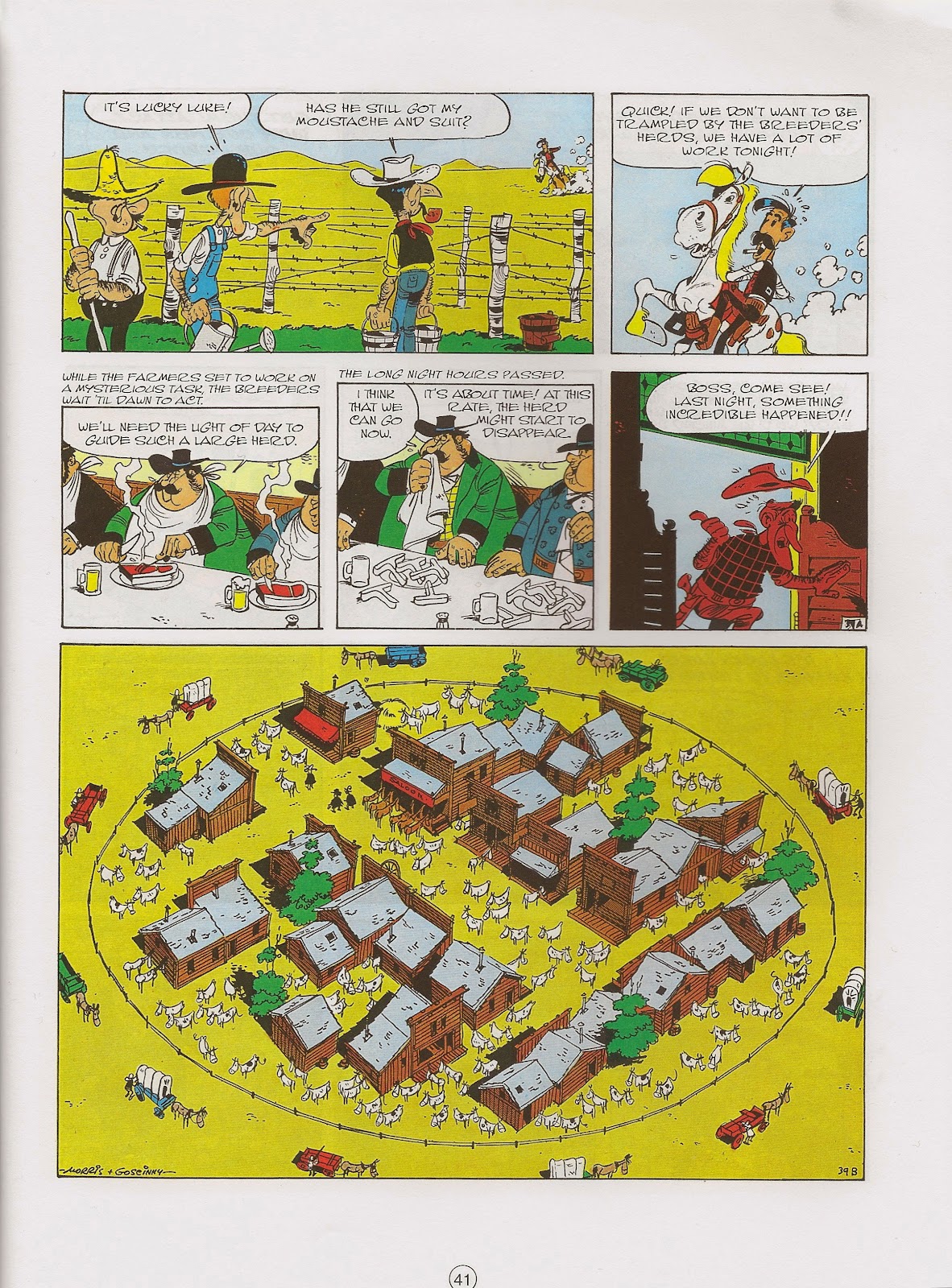
Reading Karl Knausgaard's A Time for Everything, a novel about angels as fierce as the ones evoked in Rilke's Duino Elegies, I thought maybe I had glimpsed some angels, or at least their reflected glow, over the past two days.


We're putting the finishing touches on our article "Literary Barbed Wire: Stretching and Cutting Barbed Wire from The Wire Cutters to 'Brokeback Mountain.'" Scanning a page from the comic book about Lucky Luke's adventures with barbed wire on the prairie (a French series that we have in translation), I remembered our French friend Celine who said she had read the whole series when she was a girl. Looocky Loooke, she said, and blushed a little when we pointed out the first name had to do with luck.


Tuesday, April 24, 2012

Brian Evenson's Dark Property


On May 1, Open Letters Monthly will publish an essay of mine called "Affliction Fiction." In it I review Brian Evenson's two new books in the context of the rest of his work.


As the essay developed, I cut pieces and added other pieces. A few of the cut sections here:


I watch eagerly for new books and stories by Brian Evenson. He’s got a wicked sense of humor, on display recently in the stories “Bon Scott: The Choir Years” and “Niue.” Imagine the awkwardness that ensues after AC/DC singer Bon Scott is found singing surreptitiously with the Mormon Tabernacle Choir, or the comic possibilities in a story named after a tiny Pacific island nation that opens with this question: “And how is it that the brooding Johnny Hellspider, long having restricted his posts to two-word comments such as “You rock!” or “Satan lives!”, has suddenly become so loquacious?”
Evenson’s quickly expanding body of work has a darker side as well. When “The Brotherhood of Mutilation” arrived in the mail, for instance, the chapbook lay on my shelf unread. It requires a certain resolve and a reasonably stable state of mind to read Evenson’s more unsettling texts; and something about the title and the cover illustration destabilized my resolve. A few years later, I had no such trouble with Evenson’s Baby Leg, despite a white linen cover marked by blood-red prints from the author’s own hands. By that time I had also read and enjoyed “The Brotherhood of Mutilation,” expanded between handsome noir covers as the novel Last Days (winner of the American Library Association’s award for Best Horror Novel of 2009).
Given my sometimes conflicted relationship with these books, I’m left to wonder about my fascination with what I have come to think of as Evenson’s “dark property” (the title of one of his best and most disturbing books). The reasons I read and return to these books are multiple; but they generally have to do with questions of who I am as a creature of language. Brian Evenson’s work explores and plays with and sometimes eviscerates that creature.
. . .

Lest the notions I have perpetrated here about Evenson’s grim epistemology discourage prospective readers, I should note again that he is a superb humorist. “The Prophets” is an excellent example, a story surprisingly relevant today as Tea Party readers return to texts by Mormon Cleon Skousen and ideas advocated by Eisenhower’s Secretary of Agriculture and later Mormon prophet Ezra Taft Benson. The story is told by a Mormon named Verl who decides his Church has abandoned Ezra Taft Benson’s teachings and fallen prey to liberal ideas that threaten the whole country:
The way it was laid out to me, Ezra Taft was the last real President of the Church worth his salt. All the ones since him were liberals, people who the Lord had inflicted upon the Church for its wickedness. Ezra Taft, though, he was a good John Bircher who saw with a clear eye the importance of our Founding Fathers’ Constitution, not to mention the evils of the Federal Government. He saw like it was in broad daylight the conspiracy of the New World Order, and to top it off he supported gardening and self-sufficiency.”
So what to do? Verl drives to Idaho, steals a backhoe and digs up Benson’s corpse. Back in Utah, he tries to revivify the dead prophet, first with cosmetics and then with electricity. Insistent on the religiously constructed world he prefers to reality, Verl reads the subsequent disastrous events as meaning exactly what he wants them to mean and remains hilariously triumphant even as the physical laws of the universe run their relentless course.

Finally, a somewhat embarrassing personal revelation. I see myself as a sharp-eyed literary critic. I discovered the source for the Freemasonic conversations in Thomas Mann’s Magic Mountain and I was the first to notice that Rilke’s ten Duino Elegies hinge on an “ineffable site” preceded by 423 lines and followed by 423 lines. So when I realized that a one-eyed character in Evenson’s Last Days gazes at Kline’s missing hand with “eyes dilating,” I figured out I was on to something important. My musings on that singular/plural paradox can be found here (http://goaliesanxiety.blogspot.com/2009/03/paragon-and-paradox-brian-evensons-last.html ). 

More recently, rereading Evenson’s short-story collection The Wavering Knife, I stumbled on a mistake in “Moran’s Mexico: A Refutation, by C. Stelzmann” and began to congratulate myself again. “The only reference to a so-called Rodriguez in my grandfather’s original,” C. Stelzmann writes, “comes underneath a photograph entitled Tortilla bereiteren.” Aha! I thought. This should read Tortillabereiterin—the “in” means woman. I made a note in the margin, ready to send on the correction for the author’s next edition. Then I turned back to the story.

C. Stelzmann is the grandson of the author of a travel book about Mexico that has been appropriated by its translator Moran, a man C. Stelzmann calls a postmodernesco and whose intertextual “translations” he decries. By the second page, a reader discovers that the grandson’s refutation of Moran has been translated from the original German by a translator present in copious footnotes that systematically undermine the claims and abilities and even the sanity of C. Stelzmann. For instance: “C. Stelzmann, who seems to have no knowledge of animal husbandry, does not realize the animal photographed is a cow, a female, and thus not likely to search for a wife”. Even as I chuckled at what unfolds as a literary-critical parody, I still plied my critic’s tools, counting up the degrees of linguistic remove from the original Mexico: 1) A. Stelzmann’s account, 2) Moran’s “translation,” 3) C. Stelzmann’s refutation, 4) the translator’s text and notes, 5) my notes on the mistakes in the German. Number five brought me up short. C. Stelzmann and the translator are both laughable characters, all too certain of their certainties. And so am I. Evenson has sprung the trap.


Brian Evenson, Director of Brown University’s Literary Arts Program, has produced a remarkable body of work over the course of fifteen years. There are novels and separately published novellas: Father of Lies (Four Walls Eight Windows, 1998), Dark Property (Black Square Editions, 2002), The Brotherhood of Mutilation (Earthling, 2003), The Open Curtain (Coffee House Press, 2006), Last Days (Underland Press, 2009), Baby Leg (Tyrant Books, 2010), and Immobility (Tor Books, 2012). There are three science fiction novels published under the name B. K. Evenson: Aliens: No Exit (Dark Horse Books, 2008), Dead Space: Martyr (Tor, 2010), and Dead Space: Catalyst (forthcoming from Tor, July 2012). There are books of short fiction: Altmann’s Tongue (Knopf, 1994; reprinted with the addition of an O. Henry-winning story by Bison Books, 2004), The Din of Celestial Birds (Wordcraft of Oregon, 1997), Prophets and Brothers (Rodent Press, 1997), Contagion (Wordcraft of Oregon, 2000), The Wavering Knife (Fiction Collective 2, 2004), Fugue State (Coffee House Press, 2009), and Windeye (Coffee House Press, 2012). There are translations: Rafael Cadenas’ The Space of Silence (with Trenton Hickman, Pyx Press, 1995), Jacques Dupin’s Giacometti: Three Essays (with John Ashbery, Black Square Editions, 2003), Jacques Jouet’s Mountain ® (Dalkey Archive Press, 2004), Cristian Gailly’s Red Haze (with David Beus, Bison Books, 2005), Claro’s Electric Flesh (Soft Skull Press, 2006), Jules Romains’ Donogoo Tonka (FORuM Project, 2009), and Manuela Draeger's In the Time of the Blue Ball (Dorothy Project, 2011). And there are introductions to books, essays, and even a literary-critical book, Understanding Robert Coover (University of South Carolina Press, 2003). Evenson’s work has been translated into French, Spanish, Italian, Japanese, and Slovenian.