Showing posts with label Julije Knifer. Show all posts

Friday, September 14, 2012

Nina Pops -- Form and Content


Artist Nina Pops (who lives in Cologne, Germany and who has done several projects with my friend Zarko Radakovic) just sent me these pages from a 76-page book of hers: "Variations on the Work and Life of the Painter Julije Knifer. Collage, 76 pages, 21 x 29.7 cm, polychrome pencils and graphite on paper and manuscript version of the book Knifer by Zarko Radakovic." 

Other pages of the book can be seen here: http://ninapops.blogspot.com/2012/04/knifer-buch.html


The works are thoughtful in that way that makes a viewer thoughtful. They raise questions. They inspire delight. They make connections and sabotage assumptions.

Some responses—first the page, then my thoughts:


The page as a whole strikes the eye. The slightly tinted paper. The lighter sheet of the manuscript page. The text in barbed-wire lines of black, some of them badly spliced. The four forms (visually related to what Knifer called meanders) in grey, red, black, and dark black. The artist's own note at the bottom right:10.1.2003 (?) 13:06 Atelier (?) Köln 1. First page of the book. Finished at 1:06 p.m. in her Köln studio on the first day of October 2003 (if I'm reading the tiny print correctly).

And already I have moved from the whole to the parts, a motion of understanding unavoidable given the nature of understanding and what Hans Georg Gadamer called the hermeneutic circle: you can only understand the whole in light of the parts and the parts in the context of the whole.

Four figures, fat figures, dancing figures one of which is bright red, dancing elephants vertical when seen separately and horizontal as a group of four, four figures that contrast in their abstraction with the scratched words and sentences of Zarko's text that would, if I could read the Serbo-Croatian (for these pages were written in 1993, in Nizza/Nice on the 23rd of March, in a year when the language was under vicious attack from all sides but might still, at least nostalgically, be called Serbo-Croatian and not yet, brutally, Serbian OR Croatian, which would sever, then, the language of the two friends Knifer and Radakovic) evoke meanings beyond the words.

This line of thinking is trying to separate the abstract from the concrete, the artist's image from the writer's words. But whatever sense that makes makes no sense, I discover as I write. In this work the lines of text and the lines of crossed-out text can be read, it's true, but they are transfigured in this context to lines that can be seen. The artist, while commenting visually on the text that itself evokes the work of the artist Knifer, has ripped the text out of its context to comment on her drawings. Her date and place and time are equivalents to the writer's place and date.

However! She has produced a book! Her work has become pages of a book. The motion goes both ways.

The manuscript page takes me back to the page in the printed book titled Knifer, to my copy of which is generously inscribed "my closest friend and spiritual brother," to page 18, to a clean page without the crossed-out words and phrases, to the page that means what it says but has lost the manuscript page's ability to mean also what can be seen.


Page 6 of the artist's book—of the artist Nina Pops, that is, not of the artist Zarko Radakovic (she has taught me to make this distinction). The text, in its filtered and fined form comprises parts of pages 20 and 21 in the printed book. The manuscript page, moved down and to the left as opposed to the one above that dominated the collage from above, is now embraced by red arms, connected to the black form above and on it—graphite indented by vertical and horizontal inlets. This almost sexual embrace leaves me gasping. "The Rape of the Manuscript." Move over, Sabine women.


Vertical fingers rise against horizontal lines. This is a different kind of embrace—phallic, it's true—but gentler in a way, perhaps because of the multiple columns, perhaps because of the light grey, perhaps because the black base is heavy (but not too heavy) at the bottom of the page and not pressing down from above.

It may also be phallic only in my mind. We'll have to ask Herr Rorschach about this one.


Notes on a text. Commentary sketched out and outlined and tied visually to the relevant passages. This artist is a careful and delicate reader.


What is above differentiated from what follows. What stands alone without margin framed by finger-jointed wood, black moulding, rabbeted respectfully. The framing I see is not to make the page pretty. The frame doesn't match the furniture in the room. This frame comments and elaborates and respects and highlights. 


I've got the appetite to write 76 responses to this set of works that is already an intimage conversation. This could be an intellectually lusty ménage à trois.

Tuesday, July 17, 2012

Pencils, Graphite, Depression, Knifer

the earlier post about a visit with julije knifer—invited by my friend and knifer's friend zarko radakovic (those were the days when a zagreb painter and a belgrade writer were linked by the yugoslav "highway of brotherhood and unity")—elicited a comment by the flowerville blogger:  


i like the drawings. besides i was at the pencil factory in cumberland where they make the derwent pencils (derwent is a lake and a river maybe and a mountain, no idea, at any rate it is a lake and a pencil....). it's always inspiring to see how writing equipment is being made and it is inspiring to see too other people use it like you.


i started to respond that my awkward drawing of knifer's pencils from germany and england, pencils used by a master of graphite works, didn't have anything to do with my own work other than being a quick note. but then i remembered that the 1995 trip led into the next several years of depression and finally divorce and to do something, anything, during that time i bought some pencils like knifer's and did a couple of drawings like his just to get a feel in my hands and back and shoulders of what it felt like to blacken paper with graphite, dark and darker and more dark, the sound of the pencil rasping against the paper, hours slipping past with something, anything, to show for it.


Friday, July 13, 2012

Julije Knifer: Meandering Coincidences

Nina Pops, Knifer Buch
Yesterday, checking the internet for news about my friend and co-author Zarko Radakovic, I came across a fairly new post by the artist Nina Pops. She lives in Cologne, as does Zarko, and they have frequently worked together. In this series, Zarko's manuscript (of his book Knifer) lends itself to Knifer-inspired drawings—the art and the writing working, at least in my mind's eye, like a pair of jazz musicians listening and simultaneously responding to one another. To see more of the works, click HERE.


Then this morning there was a comment on an earlier blog post that referred to Knifer (click HERE). It was from a woman interested in Zagreb, Croatia and in art history. Her blog, which has numerous posts about art in Zagreg, is HERE. She asked me about my reference to Knifer, to a visit with him in his Paris apartment. 


Zarko and I had spent the previous day with Peter Handke at his house in Chaville, just outside Paris, walking with him through the surrounding woods (in the Niemandsbucht) for hours. Still under his influence, we visited Knifer.


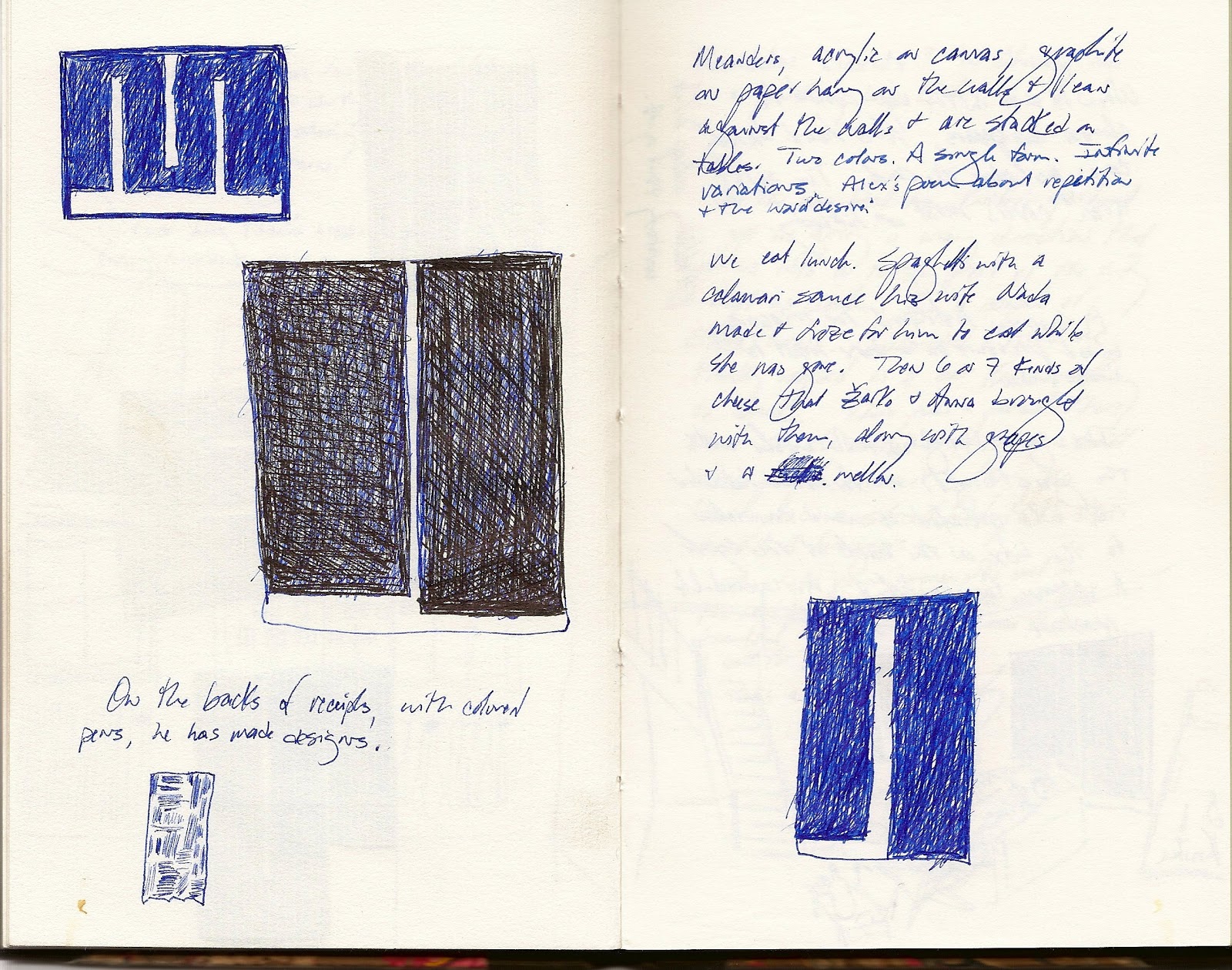
Stimulated by the Nina Pops drawings and by the question about Knifer, I got out my journal from that trip. Here are the pages, 9 December 1995:


Finally, Zarko's book, which I leaf through often, trying to pick out phrases I recognize, gazing through the Serbo-Croatian sentences as if through a glass darkly, hungry for the thoughts and structures of my friend's mind.


Friday, October 7, 2011

Hyunmee Lee's "chunji-changjo" (heaven and earth)


The painting is signed LeeHyunmee, the artist's name in her native Korean. But Hyunmee is also an American and so the catalogue for the USU exhibition of the "Creation" paintings called her Hyunmee Lee. The difference in cultures and languages feels to me like a good metaphor for the differences between how Hyunmee describes her painting and how I receive it.


chunji-changjo is the Korean. "Heaven and earth" the English.


Living with the very large black-and-white painting for a couple of years now, I find my mind and my feelings tending away from heaven and earth and feeling their way toward consciousness and subconsciousness, toward what is simply/complexly the case and what human consciousness makes of that.


Frank McEntire, a fine sculptor himself, quotes Hyunmee in the exhibition catalogue to the effect that the Zen concept of "ch'i," the life force, is the life of her paintings.


I have as little personal sense for "ch'i" as I have for heaven. What I do have is an ongoing visceral response to the painting that has a powerful conceptual component.


It's a dark painting for me, especially when I'm gripped by melancholy (a richer word than depression). It weighs heavy on me, so much so that at times I can't stand to look at it. If I do look at it in that mood, I can sense my life slipping formlessly and helplessly down off the canvas.


At other times, however, in other moods, what I feel about the weight and direction of the blackness is tempered by the scratchings and markings and scrumblings (Frank's word) in the black and across the black and even aside from the black. They are the workings of the eye and the mind and the hand of a human being. They seem like attempts to find patterns, to understand forms, to create meaning out of chaos.


In these moods I look to the right of the painting and see what my mind's eye takes to be a "5." Or it could be a "b." Or it could be the accident of an artist's gesture with a brush and paint. In any case, I see it as a sign created to make sense of the inchoate, a letter or number with which to create meaning.


Okay, it's ambiguous, it's only partially clear, it may be an accident; but it's delicate, it has a light and thoughtful form, it is the antithesis of the heavy and sliding blackness.


And that's all I really need, a simple antithesis on whose structure I can stretch my emotional and rational self (I almost wrote "selves" -- "zwei Seelen wohnen, ach, in meiner Brust").


Heaven and earth. Consciousness and subconscious. Chaos and order. Whatever it is, it (usually) works for and in me.


ADDENDUM:


Hi Scott,

How are you?  It's a wonderful news.  Just read your interesting writing and I enjoyed it. 

Just a short note about the gestures and black color in my work: 
The strong black gestures moving across the surface of large canvas was beginning of my "meditative gestures".   The large dark gestures are influenced by Taoism and Buddhism; the black unifies and bridges the harmony of energy (chi).  The black color is very special to me, for me black is much more than just feelings (and white is full as empty canvas.)  The black color is a window, it opens to the another world (far from a physical world), so my black is lighter than any other color.  Hope to enjoy the painting and you could move into a realm of progression of balance.

Thanks for the email!  We are doing great!!!  Say hi to Lyn!!,

Best,
Hyunmee

RESPONSE:

Hyunmee,
thanks for your thoughts about your painting.

I'm intrigued by your idea of seeing the black as a window, as lighter than any other color. It reverses the polarity for me and just now, watching the motion of the black on the white, I could feel it lifting and rising like a balloon.

Why not, indeed, see the white as "full as empty canvas" and all the various black markings as the signs created by a hopeful and thoughtful artist.

I'll never see it as you can, of course. I'm just not equipped to do so. But to live with the painting and to see it and feel it and to think about it like I'm doing now will make it a fine companion for the coming years.

Been thinking a lot lately about aging, especially in conversations with Alex and Sam. Health and sickness. The inevitable winding down -- entropy is in fact the law. But until it all goes black (or white), there's still the back and forth out of which we fashion our lives. That's the ongoing power your painting has for me, Hyunmee, the interplay, the dialectic, the bridging, the tension out of which life proceeds.


MORE THOUGHTS IN THE MORNING SUNLIGHT


The comment by the flowerville blogger has reinforced my sense for how important this work of art (any work of art) is as it raises questions and stimulates the desire to work them out.


This morning I looked more closely at the white paint Hyunmee starts with. In my mind it was just white, just a background for the black. But when you really look at it, the white is as thick and rich and marked as the black.


It makes me think of Zarko's friend Julije Knifer, about his paintings that began with multiple layers of white, layer after obsessive layer of white, putting off the moment he feared, when black would enter the picture. Here a couple of photos from Zarko's experimental book called "Knifer" that show the painter before unfinished canvases.
photos of julije knifer at work, by zarko radakovic

And then I think of snow and the marking that comes from our entering that uniform covering of the familiar.


Finally, another Knifer meander and a link to an earlier conversation about Knifer which, surprisingly (or not) also involved depression: http://goaliesanxiety.blogspot.com/2010/02/meanders-zarko-radakovic-julije-knifer.html


Thursday, February 11, 2010

Meanders: Zarko Radakovic, Julije Knifer, Storytelling


3:23 a.m. For sleepless hours the title line from Richard Thompson's "From Galway to Graceland" has been flickering in my mind, catching like a torn toenail on the loose fabric of family worries and job worries and restless turning and a recurring need to pee. I pull out Zarko's description of his trip from Germany through Zagreb to Pristina on the occasion of Slobodan Milosevic's catastrophic speech at the field of blackbirds, Kosovo polje, read his careful cadences, follow his restless mind, enter his world just as he finds an old friend:

. . . we walked listlessly down Amruš street, whose meandering course took us unfailingly to the house number thirteen.

At Julije Knifer’s, the atmosphere was “cozy.” The dog gnawed at one of my shoes. Nada was coating eggplants with bread crumbs. Ana was unaffected and sweet. Knifer, as always in similar situations, held his joined hands at the nape of his neck. Those were moments of pure feeling, of clear looks and inner peace. Even the voice of Slobodan Miloševic on television was slightly more restrained.

Zarko once took me to visit Knifer in his apartment in Paris. Paintings of meanders everywhere. And in the night I ease my mind into slow meanders, let the ticking clock move me along the currents of black paint on white, of simple form.