 |
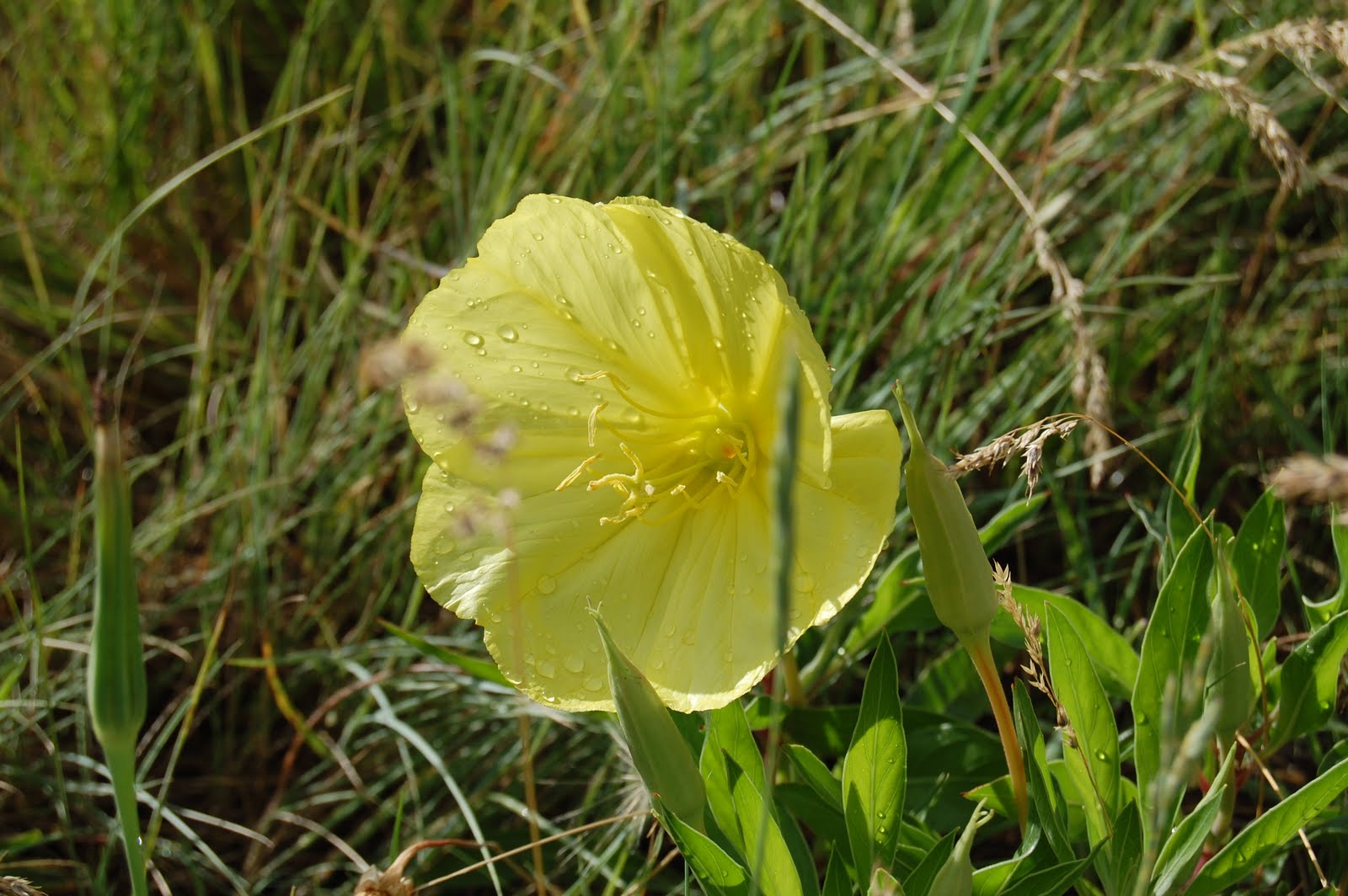
| primrose |
What a pleasure to have slow summer mornings before me and a slow book to help me enter into the day.
This primrose, growing just off the deck, has a new blossom this morning. How is it possible that a plant in this semi-arid place can risk such delicate and showy flowers that last for only a single day?
More understandable are the red paintbrushes just east of the primrose that love proximity to sage and rabbitbrush. Their red tops aren't even flowers, but bracts, and their flowers much less conspicuous.
 |
| paintbrush in sage and rabbitbrush |
Now to the book.
Several times in Chapter 7 there are references to films, as there have been throughout the novel. The actor often compares what he is experiencing to something in a film.
Chapter 8 begins with just such a reference: "He walked like an Indian in a film by John Ford who, in his own language, in Navajo, described a way of walking . . . 'Haske yichi nixwod,' which in translation means something like 'the one who walks with determination'" (or precision, or certainty).
A little earlier in the book (p. 170), the actor is about to kill someone with a hatchet when a scene from the screenplay for his film comes to mind and he goes on his way instead.
Films (and books and religious rituals) offer us patterns for living our lives. John Ford's "Young Mr. Lincoln" offers the protagonist of Peter's "Short Letter, Long Farewell" a kind of coherent (if obviously / because obviously fictional) story at a time he has lost coherence.
And here the actor draws on the memory of a film to provide impetus and form for the next station in his journey. At least that's the fiction of this novel. In all likelihood, however, as he was writing this part of "The Great Fall," Peter fell back on something he had read in "Die Presse":
Oder man sieht sich einfach in Razor Saltboys Zimmer um. . . . Er arbeitet im Gesundheitszentrum in Window Rock, der Hauptstadt der Navajo Nation, und verdient nebenher Geld als Musiker – daher der eher ungewöhnliche Name. Seinen richtigen Namen, den Navajo-Namen, kann nämlich kaum mehr jemand aussprechen: „Haske Yichi Nixwod.“ Der mit Bestimmtheit geht. (Norbert Rief, Die Presse, February 15, 2008)
There are indeed Navajo actors in John Ford's films, most often when Monument Valley is featured; and Navajos love to watch the films at Gallup's drive-in theater where they honk their pick-up horns in response to the often comic and even salacious things said in Navajo where Ford required something in an Indian language.
So Peter picks up the article in "Die Presse" and conflates it with John Ford and he has what he wants here, which is direction for the actor from film (as he had direction for the actor from the mass in the previous chapter).
At least that's how I see it.
The chapter has a couple of strong reminders that the narrator is working here, moves that remind me of Brecht's Verfremdungseffekt, assuring that we won't get caught up in identifying with the actor as opposed to paying attention to the sentences and to the novel as text. The one is the assertion, repeated before, that "my actor . . . ." The other comes when the narrator adds a statement that the actor had, along with the priest's robes, stitched up his own coat while in the church after the mass: "I forgot to mention that" (204).
There's a scene in this chapter in which two policemen confront the actor. I laughed as the actor confronted them with reference to their language: "'Your way of signaling is not aesthetic!" In response one policeman taps on his holster.
It reminds me of the morning Peter left the Salzburg jail and told the waiting press he hadn't called the policemen Nazi pigs, he had said they were "like" Nazi pigs.
Like the Salzburg police, these officers aren't keen on linguistic distinctions. Only after a forcible search to determine that the actor is neither a terrorist nor a suicide candidate do the policemen let him proceed.
He sleeps for a while on grass, wakes up to find himself, suddenly, experiencing "Zeitnot" (time emergency, the distress of time, time urgency, even time peril): "He had had enough time just now, and suddenly he had no more."
Zeitnot leads to Durcheinander, to a mixing up of things, to confusion. He can think only in numbers (earlier he killed, in thought, the berry picker who was reciting numbers), can hum only Schiller's "An die Freude." This Schiller reference made laugh. Such a cliche?
The actor comes out of the condition, as he has before, by being his own audience, the way a drunk sees another much worse drunk and then sobers up.
The chapter ends with a dialectic: aren't both idling and having no time necessities.