Showing posts with label Peter Handke. Show all posts

Wednesday, October 31, 2012

The Stillness of the Outhouse: Peter Handke's Versuch über den stillen Ort


Peter Handke's new book just arrived, his fourth in this series of essays (following the essays/Versuche on the jukebox, on tiredness, and on the successful day). I once pointed out to him that in that latter essay he writes about a Van Morrison song called "Coney Island," but misplaces the Irish island to New York. He smiled and didn't seem too concerned.

Like the other essays, this one comes handsomely wrapped in the first page of the manuscript, written in pencil, like all of his work, and exhibiting interesting deletions and additions.

The quiet place of the title is a succession of outhouses, public and private restrooms, and finally a quiet residence between fields north of Paris (Marquemont) where he writes the essay.

Why are the family's little room with a hole that empties directly into the manure pile of the barn below, the cold restrooms of the Tanzenberg seminary, the trainstation toilet where he spends the night after graduating from public school in Klagenfurt, the university restroom in Graz where he washes his hair, the temple outhouse in Japan, restrooms in French cafes, the public toilets on the Portugese coast -- why are these still rooms worthy of an essay? Because they are places where the young Peter Handke experiences versions of himself, where he has an identity separate from family, where there is an "I" different from the "I" determined by others and by their language.

The public places are wide and open as the word "Platz" indicates etymologically (wide, plateau). The places where one can pee and shit are narrow and enclosed, as the word "Ort" points out (pun intended -- the root means point or edge). In short, they are places apart, Ab-ort, away/apart/separate/out.

It's the dialectic between the two kinds of places that the text investigates. The still outhouse / Abort isn't a utopian place but rather a place that collects and stimulates and supports feelings and thoughts that then enable and even require a return to the group. 

There's a scene reminiscent of the short essay in "Once Again For Thucydides" about various head coverings in Skopje in which Handke watches people walking on a path in a park of Cascais, on the Portugese Atlantic, headed to and returning from the public toilets. The "I" that he is, or the other "I" that he is, or the others, he writes, needs such a coming and going. He compares the train of people with people in a church who are going to receive communion and finds communion with them even as or because the communion is enabled by the outhouse where they can be alone.

In the novel "The Great Fall," by the way, the narrator similarly juxtaposes communion in a church and a kind of communion in a pissoir.

There's a very interesting account of the young Peter Handke refusing invitations to travel with his classmates after graduation. Instead he travels by himself from village to town, finally spending a cold night curled around a toilet in the train station. He writes about how that became, in the novel "Repetition," the story of a similar young man traveling across the Yugoslav border to Jesenice and spending his first novel in a niche in the side of the train tunnel between Austria and Yugoslavia.

Zarko Radakovic and I followed that character, Filip Kobal, across the border for our book "Repetions." Zarko took a photo of the tunnel.


. . . we sloshed through grey and yellow, chemically fortified rain to the train station restaurant where Filip Kobal sat one whole night drinking sweet, flat, east-block Cola. A picture of Tito figures prominently in the story, but yesterday we couldn’t find it. Disappointment. And yet the thought of political change was bracing. Žarko checked the WC to see if Handke got it right. He did.

We looked for the mouth of the train tunnel where Filip Kobal spends his first night, unwilling to leave the border, the threshhold: “The tunnel did not strike me as an insane idea.  I would go in where my train had just carried me out.” We drove and walked up a dozen blind alleys before a wet garden path almost accidentally brought us face to face with the tunnel. Standing in the streaming rain Žarko photographed the heavy stone arch and the black half circle it creates.

Finally, Peter's essay awakened memories of my own, some of them related to still places where I was alone, others to actual restrooms.

There was the Thanksgiving in our house in Farmington, New Mexico, the single-storey, 3-bedroom house shared by nine of us. I think I was in high school, but it might have been a Thanksgiving trip back from the first year of college (Peter's essay is meticulous about revealing questions, doubts, ironies -- about undercutting itself in a attempt to be truthful). I left the bustle and noise and walked through the cold wind and spitting snow to drop off the edge of the plateau where the sub-division was built, into a little canyon where I curled up, out of the wind, in an indentation in the sandstone. The solitude overcame me, a splendid food to fit a hunger I had only subconsciously. I was apart, an "I" other than the "I" my family knew and shaped. When I returned to the house I was quieter, happier, more able to again be part of the crowd.

I remember working on a drilling rig outside of Farmington. The driller who had hired me was a quiet man, tough, slow moving, 45 or 50 years old. As we drilled through various geological formations there were times when decisions had to be made. If they were complicated decisions, the driller would shut down the rig, leave the floor, walk across the yard to the outhouse, lock himself inside there for however long it took him to think through the problem, and then return to tell us what to do.

There was an early morning in Farmington, about 5 a.m., when all I could think about was the hotel restroom that was waiting for me about halfway through my delivery route (bundles of the Albuquerque Journal meant for restaurants, paperboys, motels, and the town's one hotel -- what was the name?). I had a bad case of needing to shit, recognized only after having left home at 4 a.m. But the hotel was coming up and I calculated I could make it that far, that long. I drove up the hotel, left the car carrying a stack of papers, slapped them down on the empty front desk, swung open the restroom door just around the corner, and, starting to relax, found that the toilet stalls now had doors equipped with locks opened only with a quarter. I had no quarter with me and I had already begun to relax and so I turned to the urinals arrayed against the wall -- not the urinals that stretch up from the floor, but the kind that jut out from the wall. Because I was taller than 6 feet, and because the urinals were positioned for people shorter than that, I left the hotel unscathed (except psychologically, of course).

The most fragrent and even sensuous toilet I ever used was the one at the visitor's center of the Glen Canyon Dam. It was a composting toilet, a sign said, with some kind of fine-smelling wood chips below. Best of all was the gentle, warm breeze fingering my naked backside.

Finally, although these stories might proliferate endlessly, I remember the night Sam Rushforth and I drove up Daniels Canyon to ski under a full moon. Skiing rhythmically up the trail, moonshadows dark against the dazzling snow, I felt a familiar distress in my bowels. Off the trail, brushed by fragrent and soft Douglas fir branches, I dropped my pants, exposed my butt to the bitter cold, and shit between my skis. Three or four times I had to repeat the act. Unpleasant as it was, there was also a solitude and beauty to those moments apart, away.

And as I finish reading the Essay, an email from Zarko:

Unbelievable. Just today I bought Handke's book and began to read. Parallel to your reading. Amazing how familiar it all is to me. I know Peter, I love him.
Yesterday I read your text about Nina Pops, in the translation by Stefan Barmann, and I very much enjoyed your thoughts, and also your rhetoric. I know you, and I love you.
Zarko

Wednesday, October 24, 2012

New Bookshelves: Horizontal and Vertical


With no remaining space for new books, I bought and assembled a vertical stand, into which I have placed many of the books I'm using for the study of the standing metaphor. A book stand for standing books, in other words.

And the horizontal shelves I built out of 2 x 12 douglas fir. 

Barbed-wire books on the top shelf, along with books by Zarko Radakovic and myself. On the second shelf and part of the third shelf, books by Peter Handke. The rest of the third shelf: books by Charles Bowden, Brian Evenson, and notebooks. The fourth and bottom shelf: books by Richard Ford, Terry Tempest Williams, Michael Ondaadje, W. G. Sebald, Roberto Bolano, Cormac McCarthy, and John Berger.

[Bust by Nathan Abbott]


Tuesday, October 23, 2012

Interview with Peter Handke


Shocking revelation by the writer from whom I've desperately tried to keep secret that I ride a mountainbike!

Sie haben sich ein Fahrrad gekauft. / You bought a bicycle?

Yes, Sir. Nach dem Tun habe ich ein Bedürfnis, aus der Beengung herauszukommen und an Theken herumzustehen. Fernsehen mag ich dann nicht, aber an der Bar zu stehen ist wirklich im Wortsinn eine Lösung. / Yes. Sir. After working, I have the need to come out of isolation and to stand around at bars. I don't like television, but to stand at a bar is really, in the sense of the word, a solution.


Sie haben zwei erwachsene Töchter, die Ihnen vermutlich nahelegen, endlich das Schreiben von E-Mails zu erlernen. Wann knicken Sie ein? / You have two grown daughters who probably impress on you that you should finally learn to write e-mail messages. When will you buckle under?

Wenn Sie das Wort einknicken noch mal verwenden, stelle ich Sie hinaus in den Regen. / If you use the word buckle under again, I'll put you out in the rain.


Was soll auf Ihrem Grabstein stehen? / What will be on your gravestone?

Mein Grabspruch ist: Bin hinten. / My epitaph is: I'm out back.


The entire interview is here:

http://sz-magazin.sueddeutsche.de/texte/anzeigen/38671/1/1


Sunday, October 21, 2012

Moravska Noc / The Moravian Night


SRPSKA KNJIŽEVNA ZADRUGA
(The Serbian Literary Cooperative), celebrating its 120th anniversary,
has published Zarko Radakovic's translation of Peter Handke's Die moravische Nacht / The Moravian Night.

And has done so before there is an American translation available.

Congratulations to Zarko, who also has a book with David Albahari, conversations about music, about to appear.


Monday, September 17, 2012

Hermann Lenz: Seltsamer Abschied / Strange Departure


Looking for good prose, hungry for the beauty of quiet sentences, I took Hermann Lenz's novel Seltsamer Abschied off my shelf. I last read it in Essen, Germany, in 1991.


I found the quiet sentences — more about them later — and I was also flooded with memories.


I was working on a book about standing as metaphor (I'm still working on that book) and had come to Essen in part because the Folkwang Museum had a sculpture by Nam June Paik that I wanted to write about, one that recreated a section of Stonehenge with televisions and electrical circuitry and video tape of the actual site. Here are a couple of photos of the piece.


I had come from Cologne, from stimulating conversations with Zarko about his work, and I had a lot to think about. Long hours of welcome solitude translated into experiences like this one:

23 May In the train — the sight of the halfmoon in a clear sky elicited a deep melancholy. I wanted only to be alone, to be immersed in the forms of nature, to be creatively engaged, to be undisturbed, sunk in contemplation. I wanted sadness and the pleasures of sadness. I wanted, consciously, absolutely nothing. In me was only the clear halfmoon through the train window that then disappeared at a curve in the tracks and yet was, surprisingly, still there, inside the train, a perfect mirroring, and then, only then, the moon disappeared.

There's still a ticket for public transportation in the book, good for 4 trips. Paid for in German Marks. 

The novel is about a writer named Eugen Rapp, a writer who is aging and whose life work has not been especially well received, a writer who is unsettled by uncertainty and yet secure in the quiet life he leads.

The first sentences, in my translation:

The painter, named Bretschneider, stood in the attic room with its new coat of white paint, looked around, and said: "There's a sign on the wall: Smoking Strictly Forbidden! Even if you can't see it."

Eugen nodded, and Herr Bretschneider looked at the corner where he had had to paint over the dark accretion of Eugen's pipe smoke three times.

 Eugen's wife is named Hanne (as is Lenz's) and this novel, in the third person, is a gently ironic self portrait. As the novel nears its end, Hanne hears that a young and very well known Austrian writer, Stephan Koval, has said in public that Eugen is one of his favorite authors. Ultimately, Koval arranges for his own publisher to take on Eugen's work. Egon visits him in Frankfurt Kronberg and is moved to see a basket "in which a colorful pair of child's pants lay next to a book, one that Eugen had written."

They sit together on a roof terrace and drink wine and listen to the quiet evening. They hear young voices and someone calls up to the terrace: "Are you Herr Koval?"

Stephan stood at the railing and looked down. — "Yes," he said — "Won't you come with us? We are going to climb over the swimming-pool fence and go skinny dipping." — "No, I don't want to do that," Stephan answered and was asked, from the darkness, what the message of his 'Kaspar' was. — "That life is hard."

In a protective tone of voice he answered, upright at the balcony railing; demanding respect. The way he had established distance without destroying the sense of connection, this was the memory that remained when he was back in Stuttgart.

There is more about a growing friendship, about Koval's young daughter, about the essay in the newspapers that bring readers to Eugen's books and changes his life, and finally about the departure from the attic room and the family home.

Peter Handke, of course, is the young Austrian author of the play Kaspar (translated into lively and provocative English by Michael Roloff) and Eugen is none other than Hermann Lenz.

Four years after I read Lenz's novel, I visited Peter Handke in Chaville, France, where he lives, and on December 21, 1995, he wrote to "Lieber Hermann, liebe Hanne . . . Inzwischen war hier ein Mormone und Deutsch-Professor aus Utah-USA, der Deine Bücher schön in sich hatte; er war in Germany sogar bei einer Lesung von Dir." (In the meantime a Mormon and German professor from Utah-USA was here, a man who had your books beautifully in himself; he even had attended a reading of yours in Germany. —from the volume of letters between the two authors called Berichterstatter des Tages).

This morning, once again, I have this book beautifully within me.

Sunday, September 9, 2012

Epigraphs for Wild Rides, Wildflowers


Reworking Sam's and my book a penultimate time, I'm thinking of epigraphs for the six sections. Here are some first thoughts, all from authors we have read and talked about together:

"Old men with dirt under their fingernails may be of some help. Old dogs who've paid their dues and been 'around the block,' who can look at their grandchildren and see a little ahead. I remember a senior anthropologist in Boston whose house was a couple of blocks from a five-alarm fire that broke out, interrupting his work. When he heard the sirens and bells he stepped outside, looked at the smoke and the ladders going up, wet a finger and lifted it, and then went back inside to rap on the keys of his typewriter again. He had been around the world and assessed a lot of fires, bar fights, auto crashes, divorce wrangles, tribal cultures, guerrilla wars, and had that dash of Churchillian dignity a wicked old, randy old sea dog has."
Edward Hoagland, Sex and the River Styx

"I wanted to know shadbush from elderberry, dogwood from chokecherry, bluebirds from indigo buntings, yellowthroats from yellow warblers, the French horn from an English horn. . . . It's not expensive to pay attention to the phases of the moon, to transplant lemon lilies and watch a garter snake birthing forty babies and a catbird grabbing some, or listen to the itchy-britches of the Canada geese as autumn waxes. We will be motes in the ocean again soon, leached out of the soil of some graveyard, and everlastingly rocking.
"That is my sense of an afterlife and my comfort. The hurly-burly of streambed turmoil will be our last rush-hour traffic—thocketing through boulders, past perch pools and drift logs. Enough, we will say, reaching tidewater. We saw enough."
Edward Hoagland, Sex and the River Styx

"Yet some of us have the nerve, the insolence, the brass, the gall to whine about the limitations of our earthbound fate and yearn for some more perfect world beyond the sky. We are none of us good enough for the world we have and yet we dream of Heaven."
Edward Abbey, Appalachian Wilderness

"This book proceeds, much the way I do, in a disorderly, relentless fashion. It is fat with contradictions but sounds one steady note: the land. . . . Here the land always makes promises of aching beauty and the people always fail the land."
Charles Bowden, Blue Desert

"Giving some new source of water to a city in the American West, for example, is akin to sending a case of whisky to an alcoholic. It does not solve a problem—it simply puts it off for a spell."
Charles Bowden, Killing the Hidden Waters

"A reader may ask: What is the writer's relationship with the place and the people he writes about?"
John Berger, Pig Earth

"When time is pulse, as music makes it, eternity is in the gaps between."
John Berger, To the Wedding

"He called and called. Standing in that inexplicable darkness. Where there was no sound anywhere save only the wind. After a while he sat in the road. He took off his hat and placed it on the tarmac before him and he bowed his head and held his face in his hand and wept. He sat there for a long time and after a while the east did gray and after a while the right and godmade sun did rise, once again, for all and without distinction.
Cormac McCarthy, The Crossing

"A time will come of course when walking, even walking in the heartland, will no longer be possible, or no longer effective. But then the story will be here and reenact the walking.
Peter Handke, Repetition


"He went back the way he had come, again taking his time, seeing everything now from its opposite side. It was as though he made the place dimensional and substantial by his walking both ways over it, granting it the same interest in going as he had in coming. To his mind it was old beyond knowing and yet new, timeless and yet momentary, so that watching it as once more it opened before him, old as he was, he was renewed."
Wendell Berry, “At Home”

Thursday, August 16, 2012

Narration

What is required to tell a story?

Jean Fremon's novel (novel?) The Botanical Garden, translated by Brian Evenson and published this year by Green Integer (the French original was published in 1988) answers the question: very little, if we're talking plot.

What happens in the book? The narrator gathers thoughts, his own and others', into little groups. The narrator proposes catalogues—of penises, for example—and admits to a fondness for taxonimies. The narrator relates details from the lives of an old woman, of a feared and beloved thinker, of his lover, of a camel, of a playwrite. The narrator thinks about narration:

"He said: to tell stories is to ratify the social. To take part in its game. Since childhood we have been constituted by stories that we have to believe in, take part in, that we have to reproduce, mimic. A cunning joining of stories fabricates the temporality into which we are thrown and gives to the arbitrary or sleight of hand the semblance of natural causes.

"To shatter narration is to kick against this, he said"

There is change over time, as befits a novel. The narrator's lover leaves him for the playwrite. The narrator's friend Karl falls ill and can communicate only by writing on a slate (the book is like a series of notes on a slate):

"Karl is doing better. He had them bringing him chalk and slate and that's how he communicates with his visitors now. It suits him well: he retains the initiative. No general conversation, useless to clarify.

"The slate is serene but absent. Far from everything. Today it told me: 'Values dislodge facts.'"

The camel, who has been acting in a play, gets pregnant.

There are conundrums:

"A rat eats of a consecrated wafer. Does he ingest the Real Body?

"If yes, what is to be done with the rat?

"If no, what has become of it?"

There are—and this is the fragmentary essence of the fragmentary book—lots and lots of interesting thoughts:

"It's as if the sentence were capable of extracting what happiness there is in unhappiness and filling our heart with this extract, just like how a very pure, very beautiful, very profound and very sad melody fills us at the same time with happiness and sadness, and the more profound the sadness is, the more the happiness flares up. . . ."

The narration, finally, puts us in the mind of the narrator and the plot is the sequence of the narrator's thoughts. There are lots of commas.

I read the book slowly, a few pages each morning over the course of a couple of months. The reading matched the writing—fragmentary, unconcerned, tenuous, patient, surprised, concerned, amused, uncertain, bored, delighted.

The Austrian playwrite is named Thomas Narr. Narr means fool in German. Narr is the beginning of narr-ation.

What does a story require? A kind of sly foolishness.

p.s. Thomas Narr reminded me, in a couple of places, of Peter Handke. His attitude towards literary awards given by people who misread his work for their own purposes, for instance, or his play "composed principally of insults directed at the spectators."

Sunday, August 12, 2012

Republika Srpska

Working today with Zarko's and my "Vampires & A Reasonable Dictionary," I got out my notebook from our trip up the Drina River Valley and found a good joke, a photo, and a document—along with some notes.


Mujo and Hasso story

Foca, bridge destroyed by a bomb from a NATO jet -- photo by Thomas Deichmann


Who bombed that bridge? the man asks me. We did, I say.

A visa allowing me to enter the Republika Srpska for "humanitarian reasons."

A fine fish dinner in Bajina Basta: clockwise--I, in the foreground, then Zlatko, then the host, Thomas Deichmann, Peter Handke, the hostess, the historian, and the blessed owner of the bus firm who arranged to have my lost notebook returned -- photo by Zarko Radakovic

Thursday, August 9, 2012

Gorazde

I'm reading/seeing Joe Sacco's wonderful book "Safe Area Gorazde: The War in Eastern Bosnia 1992-1995."

This drawing brought back memories (see below). We had tea that day in 1998 in one of the low buildings to the left of the wide opening just before the bridge.


Goražde
Up the Drina River, past the hydro-electric dam and the reservoir, Zlatko pilots his Peugot through a dozen tunnels. A railroad track with its own network of tunnels snakes along the opposite side of the river. In ten minutes we reach Muslim-held territory. There are, contrary to my expectation, no borders to cross. Since the Dayton Accord, explains Thomas, this is one country.  
Border or no border, the tension in our little car rises as the familiar ruins begin to appear, Serb houses this time. We have been welcome in the Republika Srpska – two Serbs, the author of Justice for Serbia, two translators of that text, and the journalist who demonstrated that the ITN photos of the concentration camp at Trnopolje were a fiction. The welcome wouldn’t be as warm here.
“Here” is a town stretched along both banks of the river. Fierce fighting with machine guns and artillery has marked, has scarred the once prosperous face of Goražde. Between the highway and the river rises the brilliant white tower and five domes of a new mosque. Goražde was taken by the Serbs and retaken by the Muslims. It is connected now by a thin corridor to the Muslim-held area around Sarajevo.

In less than five minutes we have passed through the town. We’ll come back this way tomorrow.        


Goražde
Late afternoon. Where the bridge over the Drina meets the main highway, we sit in front of a cafe and drink “chai,” which Zlatko pronounces with a careful and delicate Muslim lilt.
No reason to attract attention, he says.
Across the street is an apartment complex. With laundry hanging to dry in every window and on every balcony, the building looks like a ratty overstuffed couch. A white truck stands in front of the building: UNHCR – United Nations High Commander for Refugees. Stacks of firewood rise high in the courtyard.
Three children run past the café. Two of the boys wear tennis shoes. The third runs with a practiced shuffle in the adult shoes he wears, their backs flattened like slippers. He looks up and smiles at us before following his friends down the riverbank.
A woman with a wheelbarrow full of kindling shoves pieces of wood into a basement window.
The main street of Goražde is called Marshal Tito Street.
Good for them, Žarko says. It’s a crime that most Serbian towns have renamed their streets. You can’t just wipe out forty years of your history.

Friday, July 13, 2012

Julije Knifer: Meandering Coincidences

Nina Pops, Knifer Buch
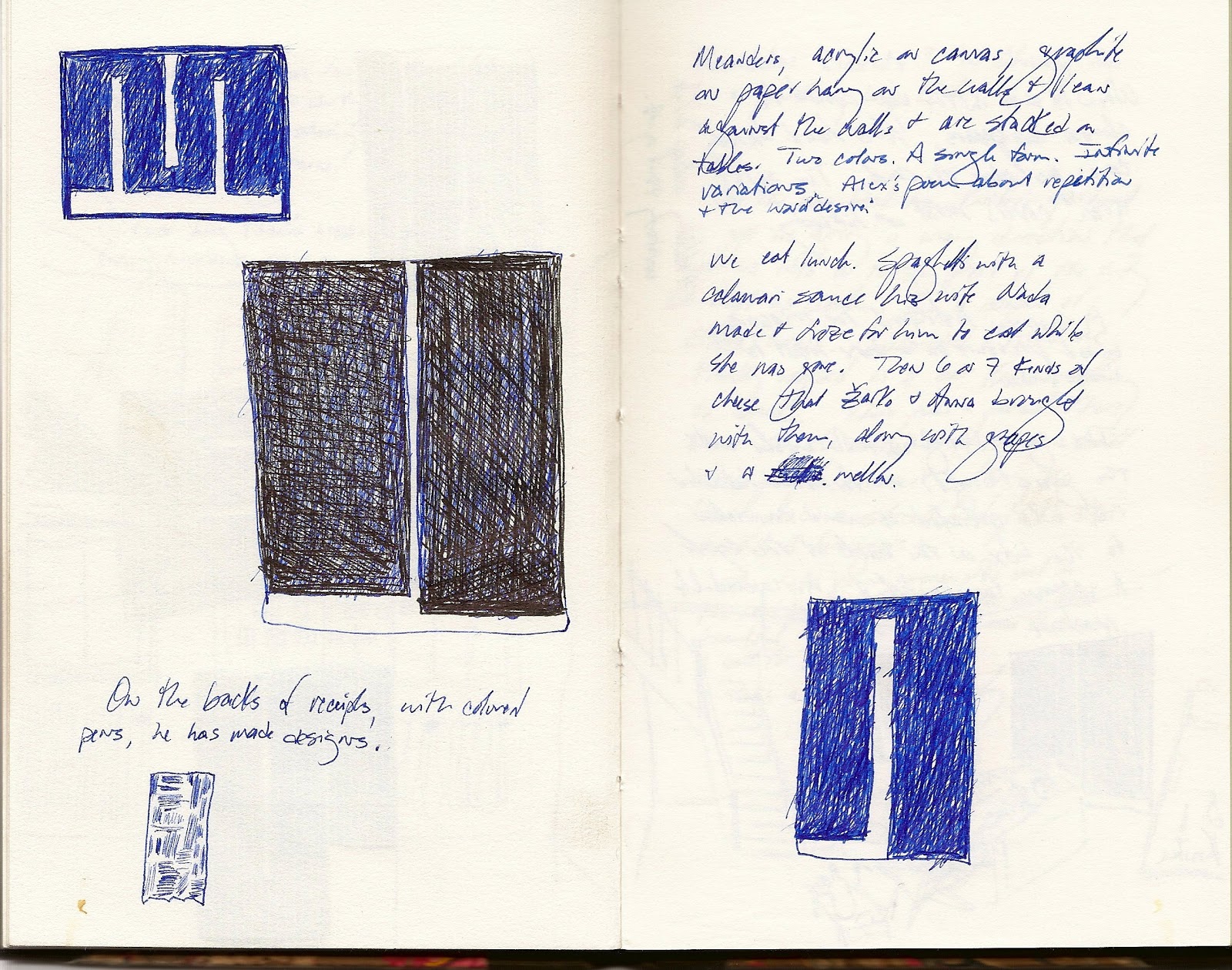
Yesterday, checking the internet for news about my friend and co-author Zarko Radakovic, I came across a fairly new post by the artist Nina Pops. She lives in Cologne, as does Zarko, and they have frequently worked together. In this series, Zarko's manuscript (of his book Knifer) lends itself to Knifer-inspired drawings—the art and the writing working, at least in my mind's eye, like a pair of jazz musicians listening and simultaneously responding to one another. To see more of the works, click HERE.


Then this morning there was a comment on an earlier blog post that referred to Knifer (click HERE). It was from a woman interested in Zagreb, Croatia and in art history. Her blog, which has numerous posts about art in Zagreg, is HERE. She asked me about my reference to Knifer, to a visit with him in his Paris apartment. 


Zarko and I had spent the previous day with Peter Handke at his house in Chaville, just outside Paris, walking with him through the surrounding woods (in the Niemandsbucht) for hours. Still under his influence, we visited Knifer.


Stimulated by the Nina Pops drawings and by the question about Knifer, I got out my journal from that trip. Here are the pages, 9 December 1995:


Finally, Zarko's book, which I leaf through often, trying to pick out phrases I recognize, gazing through the Serbo-Croatian sentences as if through a glass darkly, hungry for the thoughts and structures of my friend's mind.


Friday, June 8, 2012

Voyage by Dugout, The Play of the Film of the War


PAJ, the Performing Arts Journal, just published my translation of Peter Handke's play about the disintegration of the multicultural federal state of Yugoslavia under intense and falsifying media pressures.


The translation began in Vienna on the night before the premiere of the play in the Burgtheater:


5 June 1999, Vienna
Žarko,
I have checked into the Pension Falstaff, just around the corner from Sigmund Freud's rooms in the Berggaße.
From the train into town I saw a hawk hanging over a hops field lined with brilliant red poppies and blue flax. Like a sleek NATO jet over a fruitful Yugoslav landscape.
While waiting for you and Anne to arrive, I’ll work on my translation of Peter’s Voyage by Dugout, The Play of the Film of the War, whose premiere in the Burgtheater we are gathering to witness.

6 June 1999, Vienna

This afternoon I walked down to the Danube. The bridges here have not been bombed. The Danube still flows toward Belgrade. And the Serbs I meet in Vienna are dealing with their stress the same way I do: by telling jokes.


Madeline Albright gives the Serbs an ultimatum: love or war! They take one look at her and decide on war.

        Later, in the city center, I stumble onto a Sunday-evening demonstration against NATO and for Yugoslavia. "NATO – fascistik, NATO – fascistik!” the crowd of maybe 3000 chants. I donate 200 Schillings to a humanitarian group and they give me a blue, white, and red Serbian flag in return. A Vienna policeman, pistol in his belt, leans against a post studying a book with the title: Learn Greek.

Back in my room, unable to sleep, I turn to my translation. I wish you were here Žarko, to compare notes. Peter’s prose is not easy to reproduce, nor are the word-images. How, for instance, did you translate “Fertigsatzpisse”? Pissing your finished, your modular sentences? Sentential piss?

At 10:30 I watch a pre-premiere report on Peter done for Austrian TV (ÖRF2). Peter’s crime, the reporter and his commentators agree, is that he is a “Serbenfreund,” a friend of the Serbs. Not good to be a friend of the enemy. Peter should have known better. It’s an old story: Jap lover, Kraut lover, Jew lover, Nigger lover, Serb lover.

I turn off the sentential piss and turn back to Peter’s play. Before midnight I’m out of paper. I write across the face of my travel itinerary. I fill margins. By one a.m., having exhausted all possibilities, I look through the cupboards and drawers in my room. The drawer of the night table opens to a Gideon Bible, in the back of which are ten blank pages. I decide the hand of God has provided and rip them out and continue translating till first light.

9 June 1999, before midnight, Žarko’s birthday

I ought to go to bed, but I'm still reeling from the events of the day. Several hours ago NATO and the Yugoslav Parliament came to some kind of agreement ending the bombing after 78 days.

And, I'm just back from the world premiere of Peter's "The Play of the Film of the War," directed by Claus Peymann. I’ve never attended the world premiere of a play of this magnitude; and I’ve seldom been this moved, this challenged, by a work of art.

Peter has filmmakers John Ford and Luis Buñuel in a Serbian town ten years after the war trying to decide how to make a film of the war. Characters who appear before the directors tell conflicting and complex stories as the play feels its way to questions about war and its aftermath. The really bad guys of the play, three "Internationals" who know all the answers, who dictate all the terms, who can think only in absolutes, appear on the stage as follows: "Three mountainbike riders, preceded by the sound of squealing brakes, burst through the swinging door, covered with mud clear up to their helmets. They race through the hall, between tables and chairs, perilously close to the people sitting there. 'Where are we?' the First International asks. 'Don't know,' the second answers. 'Not a clue,' the third says." 

American and European moralists, functionaries with no hint of self-irony or humor, absolutists who run the world because of their economic power – these sorry excuses for human beings were depicted this evening as mountainbike riders.

            Žarko, I said, Don’t you ever tell Peter I ride a mountain bike.

            No, he whispered, I’d never do that.

            The play drew on several incidents from our trip, including when Peter put his coat around the shoulders of the OSCE woman in Višegrad. After the performance, flushed with enthusiasm and insight, I told Peter how well he had integrated that real event into an imaginative play.

            “Dr. Scott,” he chided. “Always the professor.”


............. for a very interesting set of thoughts about the play, by early Handke translator Michael Roloff (Kaspar, The Goalie's Anxiety, etc.), click HERE

Monday, June 4, 2012

Günter Grass’ Bombshell Poem “What Must be Said”

i got this print in germany while working on grass' novel The Flounder


Two months ago today the Nobel-Prize winner published a poem in the Süddeutsche Zeitung that elicited some thoughtful remarks:


Günter Grass is a NAZI. Günter Grass is an anti-Semite. Günter Grass is odious. Günter Grass has committed a mortal literary sin. Günter Grass has propagated blood libel. Günter Grass is persona non grata in Israel. 


Not since Heinrich Heine's "The Silesian Weavers" earned jail time for anyone caught with the poem on their person ("A curse on God, King, and Fatherland!") has a poem drawn such attention.

The poem has three basic threads of thought. The first is about why the poem’s persona has remained silent about a country he hesitates to name because of his own country’s guilt vis-à-vis that other country. The second is about the threat of nuclear weapons in the Mideast, about Israel’s nuclear capabilities and Iran’s potential nuclear capability, and about a threatened strike by Israel against Iran. The third is about the morality of supplying a German-built submarine to Israel.

First thread:
Why, however, was I silent until now?
Because I thought my ancestry,
afflicted by a never-to-be-overcome stain,
requires that this fact never be spoken as truth
about the land of Israel to which I am bound
and want to remain bound.

Second thread:
It is the asserted right to a first strike
that could eliminate the Iranian people
enslaved and made into organized celebrants
by a mouthy hero because in his realm an
atom bomb is supposed to be in construction.   

Third thread:
. . . my country . . .
is to deliver an additional submarine
to Israel, whose specialty
is to have the capability of directing annihilating warheads
to where the existence of a single atomic bomb is unproven,
though fear wants to provide the proof . . .

Why does the persona break the inhibitions of thread one to assert what he sees as the facts of thread two in order to hinder the business transaction of thread three?

Only thus can all find succor, the Israelis and Palestinians,
and beyond that, all people who live densely packed together 
as enemies in these 
regions occupied by insanity
and finally we too.

What will be the punishment for doing so?

. . . the verdict “anti-Semitism” is understood.


Vergangenheitsbewältigung! This eight-syllable word with its hanging and rising consonants (four g’s! htblt!), this single word that might translate as an overcoming of or a coming to terms with the past, raises a powerful question: how might the German language be remade as a tool of reason and peace and humanity after having been a blunt perpetrator of Nazi ideology? The answers are legion and their names are Günter Eich, Ilse Aichinger, Heinrich Böll (Nobel Prize), Ingeborg Bachmann, Günter Grass (Nobel Prize), Peter Handke, and so on. 

Grass once argued that “Adorno’s claim that after Auschwitz no more poems could be written has provoked so many misunderstandings that the following interpretation ought to be appended, at least tentatively: poems that have been written after Auschwitz will have to submit to being measured by Auschwitz.”

Measuring his own silence and then his own desire to speak by that standard, Grass’ persona says what he thinks must be said. He says it carefully, almost torturously, bending and twisting his sentences and lines to say it with strong nuance.

He says it in the context of six decades of literary work that includes The Tin Drum, Cat and Mouse, Dog Years, Local Anesthetic, The Flounder, and other works that investigate ideologies and mythologies and lies perpetrated by the German language (and by extension by all languages and even by himself: "I am skeptical even of my own skepticism"). My analysis of some of these can be found HERE and HERE.

And now, because he has dared to utter the word "Israel," he is suddenly and certainly a Nazi, an anti-Semite, a persona non grata.
The furor is telling, indicative of a coercive herd mentality, of "accepted ideas" a la Flaubert, of a level of intelligent public discourse that has gone extinct.

In 1996 Peter Handke ran into a similar buzz saw when he published, also in the Süddeutsche Zeitung, his long essay A Journey to the Rivers: Justice for Serbia (the English version, in my translation, Viking, 1997). Like Grass, Handke was concerned about the use of language, of rhetoric, of silence. Like Grass, Handke was branded an unregenerate and dangerous enemy of democracy. While Grass’s sin is anti-Semitism, Handke’s was being a Serbenfreund, a friend of the Serbs. Like Grass, Handke was accused of saying what any reader of his text knew that he hadn’t said. In The New Republic, for instance, the German writer Peter Schneider, like many others elsewhere, accused Handke of denying the massacre at Srebrenica. Because he couldn’t or wouldn’t read, Schneider ignored explicit passages of the text: “’What, are you trying to help minimize the Serbian crimes in Bosnia, in the Krajina, in Slavonia, by means of a media critique that sidesteps the basic facts? . . . You aren’t going to question the massacre at Srebrenica too, are you?’ ‘No,’ I said.”

How does one argue the merits of a text, of an argument in words, with zealots who don’t care what the text says? How does one argue with zealots who demand that there be no argument? How does one break silence when silence is demanded?

For my fairly literal translation of the poem as well as Michael Roloff’s comprehensive (and amazing) collection of links to responses to the poem (and to a second poem Grass published about Germany's relationship to the Greek financial meltdown), see the hundreds of comments to this earlier post


Michael Roloff has a most thoughtful summary discussion of the controversy HERE (scroll down just a bit to find the colorful essay).

Friday, May 11, 2012

Janice Hilton Abbott: A Conversation between Two of Her Sons


For some reason John heavily annotated my twelve pages [of memories of and thoughts about our mother].
I began impersonally:
Shocked by his mother’s suicide, Peter Handke decided to write his memories of her. He thought that such a sorting out would make her more real to him, that he could learn to know her better, that he could save at least her memories by writing about her. He began confidently; but the more he wrote the less he understood his mother. . . . As the book progresses the paragraphs grow shorter and finally dwindle to fragments. At the end Handke writes: “I’ll write more exactly about her later.”

John ignored the theory. His first note is an answer to my question about place: “Junior Sunday School. Montpelier, Idaho. Or was it Paonia, Colorado? Sunday after Sunday she stood in front of us and taught us to sing. Filled with her warmth, basking in her love, bursting with pride that she was my mother, I told myself she was the most beautiful woman in the world.”
Montpelier, John wrote.
I mentioned a few memories from Montpelier, including acting in some play or pageant, an ignominious role that required lipstick. John wrote: it was in Farmington for me, living at Grandpa's. I didn't go to school, because it took soap to wash the lipstick off. I'd already had my mouth washed out with soap.
I remembered feigning cramps to avoid swimming lessons in the freezing water of Bear Lake. John noted: never knew you pulled the same stunts. You were my idol. I wrote about ice skating, and John commented: frozen hands, no ability, too young, not as good as you -- ever, till manhood.
Manhood.
I mentioned “early, happy memories in a less-than-pleasant physical environment (our little house out of place among the warehouses butted up against the railroad track): Mom gave meaning to those early, potentially destructive years. What I don’t remember from that time is a sense of shame.” John drew a line from the word “destructive” to the margin and wrote: for you, no! for me, yes! For some reason he crosses out the word “shame” and writes no humanity.


John placed a cryptic “NS” after a paragraph about a photo of Mom as an object of desire.   Did my mention of our parents’ sexuality please him? Disturb him? Or does NS stand for a sarcastic “No Shit!”
Beside a paragraph describing a long family hike around Shiprock and the sleepy ride home made electric by the sight of my newly captured bull snake crawling up Mom’s leg, John wrote: I remember this. I didn't want to go. He often didn’t want to go. There were times when the sheer size of our family made me wince as well.
I wrote: “Kneeling around the table for family prayer.” John filled the margin with: Remember when Carol was saying the prayer and the phone rang. She hurried her prayer, jumped up, and grabbed the phone. "Heavenly Father," she said, and dropped the phone. Even Mom, next to the phone, was laughing and coughing so much that she could hardly answer the phone, which was for her.
I recounted a fond memory: “One night I awoke to find Dad shaking my shoulder. He hurried me into Sunday clothes and rushed me off to the Elk’s lodge where he and Mom had gone to hear an Australian boys’ choir. I thoroughly enjoyed the second half of the program; but my strongest memory is of gratitude that they went out of their way to share the experience with me.” John commented, with an interesting choice of prepositions: Never did this to me.
I described Mom hobbling around the house with a broken toe, the victim of her temper, and asked “How did the sides of her mouth survive those vicious chewings?” John's comment is Ya!!
Then there is my statement about “the tender new mother (for the eighth time) with baby Jeff,” to which John affixed the words: Another brother. A year after Jeff was born John did a science-fair project nicely related to those family population pressures: “The Effects of Different Amounts of Space on the Number of Fruit Flies (Drosophila melanogaster) Produced in the F1 Generation.”
Next to my memory of hiking trips with Mom and Dad, John noted his own memory: Mom a Cub Scout Den Mother while pregnant with Jeff. Pregnant lady followed by ten cub scouts. Very humorous.
There’s a paragraph about picking up Paul from his mission in Zurich, about the testimony meeting at which Mom emphatically described her visit, just a week before, to Christ’s garden tomb: “I can’t help but think of Sesemi Weichbrodt’s words at the end of Thomas Mann’s Buddenbrooks: ‘It is so!’ she said with all her strength and glared at the others. She stood there – a victor in the good fight. She had fought her life-long against doubts from her school-teacher rationality – bent, tiny, shaking with conviction, a small, fierce, enthusiastic prophetess.’” John wrote: She, as Mom, are victors!!
After my description of Mom as a fine and strict first-grade teacher, ending with “I wonder how the children view Mrs. Abbott?” John noted: An invigorating teacher like Mrs. Anderson, my 1st teacher. Teaches from love, not $. They viewed her as I viewed Mrs. A., a Goddess. I've seen her students introduce her to their parents. I've seen parents thank Mom for being their children's first grade teacher. Mom's a teacher like Dad was. Mom, they need you.I praised Mom’s grit after Dad was killed: “The determined Mother and provider, back in school again at a ripe middle age. Surely an act of courage. But then again, she enjoyed it so much. No one would ever choose that route, but Mom positively flourished.” John expressed regrets I recognize: I disappeared for quite a few years. No help. No compassion. Nothing. Thanks Mom. I love you.
I criticized Mom’s frenetic walking habits, antithetical to contemplation and conversation, and John again defended her: No, she thinks more as she picks up speed. Give the woman credit. She's good at being a friend, even if she's herself. Scott, did you give her a chance to be herself? Probably not! Just you as her son yet intelligent? I spent 2 months with my mother. She won't accept what I do, but we finally became friends.
John, how could you become friends if she won’t accept what you do? You argue here for accepting her, for letting her be herself; but what if “herself” is antithetical to “yourself”?
Then so be it, you answer back. She took me in for two months when I needed a break. She is my mother.
I referred to Mom as a grandmother. John wrote: I've never seen Mom as a grandmother. I guess it's because I have no family but the one I grew up with, except for Carol's kids.
John had advice for me when I admitted that it’s best for me not to talk politics with Mom: You're afraid!! I spent 2 months with Mom. You have to make her be honest, and you have to be honest in discussion. It's not easy, but it works!
In one entry I tried to analyze difficulties I have talking with Mom: “Those phone conversations when Mom asks: How are you doing? Always an awkward silence because I know she really wants to know. And doesn’t. No matter how well I am doing, an honest response makes her worry and sets me up for an even more searching question the next time she calls. But if I don’t tell her the truth, we don’t communicate either.” No!! John wrote. Scott, what's a mother to do? She loves us. We don't let her accept us and we don't accept her as her. We have to accept each other! Mom's a person herself. Share her right to believe! Are we friends, my brother?
This question undoes me every time I read it.
“It’s a pleasure to see how proud Mom is of us,” I wrote, and John noted, with his trademark double exclamation points: She's even proud of me!!
My fragmentary essay ended with the words: “Merry Christmas, Mom. I love you dearly.”
John added sentiments that quicken my heart: Love you too my brother!
It is a conversation of sorts. One text engenders another. The disturbed man who told his sister she was dead defends his mother and expresses love for his brother. The man who claims to have no desires reveals how he values his mother’s pride.
Precious words, heart-rending in their fixed paucity.