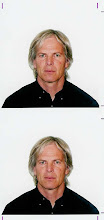
Monday, May 14, 2012
I Was Never a Bully in High School
He was incensed that a boy had long blonde hair and led other boys to hold him down while he cut his hair.
Who would do that? I asked.
Didn't you do things in high school you're not proud of? Mom asked.
Of course I did. But I was never a bully!
And I never was. I can't even imagine that kind of action. What I can imagine is standing up for someone weak against someone stronger. I have done that repeatedly over my career at four different universities. My first impulse is in favor of the disadvantaged. That informs many of my personal and political choices.
Mitt Romney's political impulses are in favor of the advantaged.
When asked about the incident, Romney claimed he couldn't remember it.
This morning I woke to a set of memories (forgotten only briefly during the self-righteous conversation yesterday) that have shaken the certainty with which I countered my mother.
While in high school, sharing a room with twin desks and bunk-beds, I bullied my younger brother John. The memories are of white-hot anger, of fights that only ended when I had my way, fights over trivialities like whether the light in the room should be on or off.
Like the boy Romney bullied, John later came out as gay.
I don't think (but I'm not sure) that that had anything to do with our fights. Romney too claimed that it never would have entered his mind that the other boy was homosexual.
My memories are clear. They are shameful. They have been with me since I left home to go to college. They inform every sentence I write as I work to overcome whatever parts of that past that can be overcome (it has been two decades since John died and the manuscript "Immortal For Quite Some Time" still has my focused attention).
The knowledge of the feelings and actions of a bully make me a better person, the person who could state flatly that I was no bully.
Now, today, and perhaps since I left home, I am not and have not been a bully. If that is true, it is only true because of the strength of the heart wrenching, indelible memories.
Mitt Romney is either brutally calloused or a calculating liar.
Thursday, March 11, 2010
Gary Bryner

Gary Bryner died yesterday. Cancer.
How to deal with the loss? Memory may be the best recourse.
In 1995 we took students to Peru, to work for two weeks on Taquile Island, at 13,000 feet, in the middle of Lake Titicaca.
Here a few notes:
8 May
A sun-drenched breakfast in the courtyard of a little restaurant. The woman wouldn't take my 5,000,000 Sole (5 new Soles) bill because it didn't have flowers in the right spot. Five years ago, Gary says, the rate of inflation was 7500% per year. In Germany, that kind of inflation helped fuel the Nazi rise to power.
I'm impressed (as I have been before) by Gary's command of the facts, facts gathered with intense energy and focus. He just finished a law degree while engaged in full-time research and award-winning teaching. And he recently turned down a prestigious position at the University of Colorado out of a sense of commitment to the graduate program in public policy he has recently begun at BYU.
We gather at the school. A Taquileno blows a referee's whistle to summon people from across the island to work on the two new rooms.
Early afternoon, exhausted by three trips up the hill carrying floorboards -- heavy Amazonian hardwood. Two cokes (who carried them up the hill?), a liter and a half of orange drink, a powerbar (hauled up the killer steps in my dufflebag), and five bread rolls later I feel like I could maybe do one more trip. Halfway down the trail I pull off and sit on a huge stone.
Sheep bleat.
Humming. Bees.
Birdwings.
A woman in a red dress carries a bulky load on her back as she walks along a row of eucalyptus trees far below.
The lake smooth in large patches. Elsewhere slightly ruffled.
A bird call.
One of the Taquile community's blue-and-white boats arrives quietly from somewhere.
A slight breeze.
Steady sun.
Thumps -- people coming down the stairs. No, it's a small bunch of sheep, herded along the trail by a young man, a load of cornstalks on his back and a radio in one hand tuned to a news program.
More bird sound.
The boat leaves, its wake an arrow toward Puno.
A little girl herds a few sheep across a terrace below.
Bright clothing drying on a rooftop.
7 p.m. In Faustino's restaurant. Close, stuffy, claustrophobic with the sound and smell of a kerosene lantern and thirty closely packed bodies. Gary comes in late. He's bundled up in several layers of clothing, including a tan parka. Its hood is pulled up over a stocking cap.
Who has diarrhea? Cindy asks for a show of hands.
All day we worked like piss ants hauling wood up from the pier. Five trips up and down was all I could muster. Fifteen boards. A tiny pile after an enormous effort. At five the head man blew his whistle and we stood there while a couple of men gave speeches in Cacao thanking us for our work and praising the community effort (at least that's what I think they were saying). Then the children came out of the school and stood in lines, the boys in black and white, the girls in colorful dresses and their head scarves. The teacher, with whistle and cap and an American flag on the front and a satin soccer-uniform shirt, stood and gave a speech. then Percy, the school president, gave a speech, then someone else, and finally the children were set free. In the meantime the schoolyard had fallen into shade and I was left shivering in the thin air in my sweatsoaked clothing. Gary too, it appears.
Monday, October 1, 2007
More thoughts on photos and meaning
Over the weekend I've been thinking more about photos, those historical/artistic records we figure will outlast us but that, in the most important sense, are as brief as our faces (John Berger).
The examples I gave of knowledge I had of the people in the 1966 photo of young men and airplanes at Lake Powell, knowledge that supposedly would disappear when I do, weren't as good as they might have been. I listed names and professions and what became of some of us after the photo was taken.
Better examples might have been taken from the thinking I've been doing while trying to read the photo for some writing I'm doing.
I was in Boise, for instance, following traces left by my brother John before he died of AIDS in 1992, when I stepped right into Larry Echohawk's campaign for Governor. The contrast between his extremely public and successful life and John's death in a cheap apartment across the street from the State Capitol was painful. Those thoughts and memories create an aura (see Walter Benjamin) that no one besides me can experience.
The future Mayor of Farmington is interesting to me because of his role in the 1974 demonstrations by Navajos in Farmington after three Navajo men were tortured and killed by Farmington High School students. The Mayor, a kind and gentle and generous man, excoriated the Federal Civil Rights Commission's "Farmington Report" as the product of a socialist government and claimed there was no racism to speak of in our red-neck, oil-boom town.
I look into the faces of the five generous men who have brought us here in their airplanes, I look at our faces, and I try to trace present and future beliefs and affiliations. I scan the photo most intensely for explanations of the racism that raises its ugly head at the most awkward times in my own psyche indelibly formed by this and other events tied to my home town.
"And our faces, my heart, brief as photos."