Friday, July 13, 2012

Julije Knifer: Meandering Coincidences

Nina Pops, Knifer Buch
Yesterday, checking the internet for news about my friend and co-author Zarko Radakovic, I came across a fairly new post by the artist Nina Pops. She lives in Cologne, as does Zarko, and they have frequently worked together. In this series, Zarko's manuscript (of his book Knifer) lends itself to Knifer-inspired drawings—the art and the writing working, at least in my mind's eye, like a pair of jazz musicians listening and simultaneously responding to one another. To see more of the works, click HERE.


Then this morning there was a comment on an earlier blog post that referred to Knifer (click HERE). It was from a woman interested in Zagreb, Croatia and in art history. Her blog, which has numerous posts about art in Zagreg, is HERE. She asked me about my reference to Knifer, to a visit with him in his Paris apartment. 


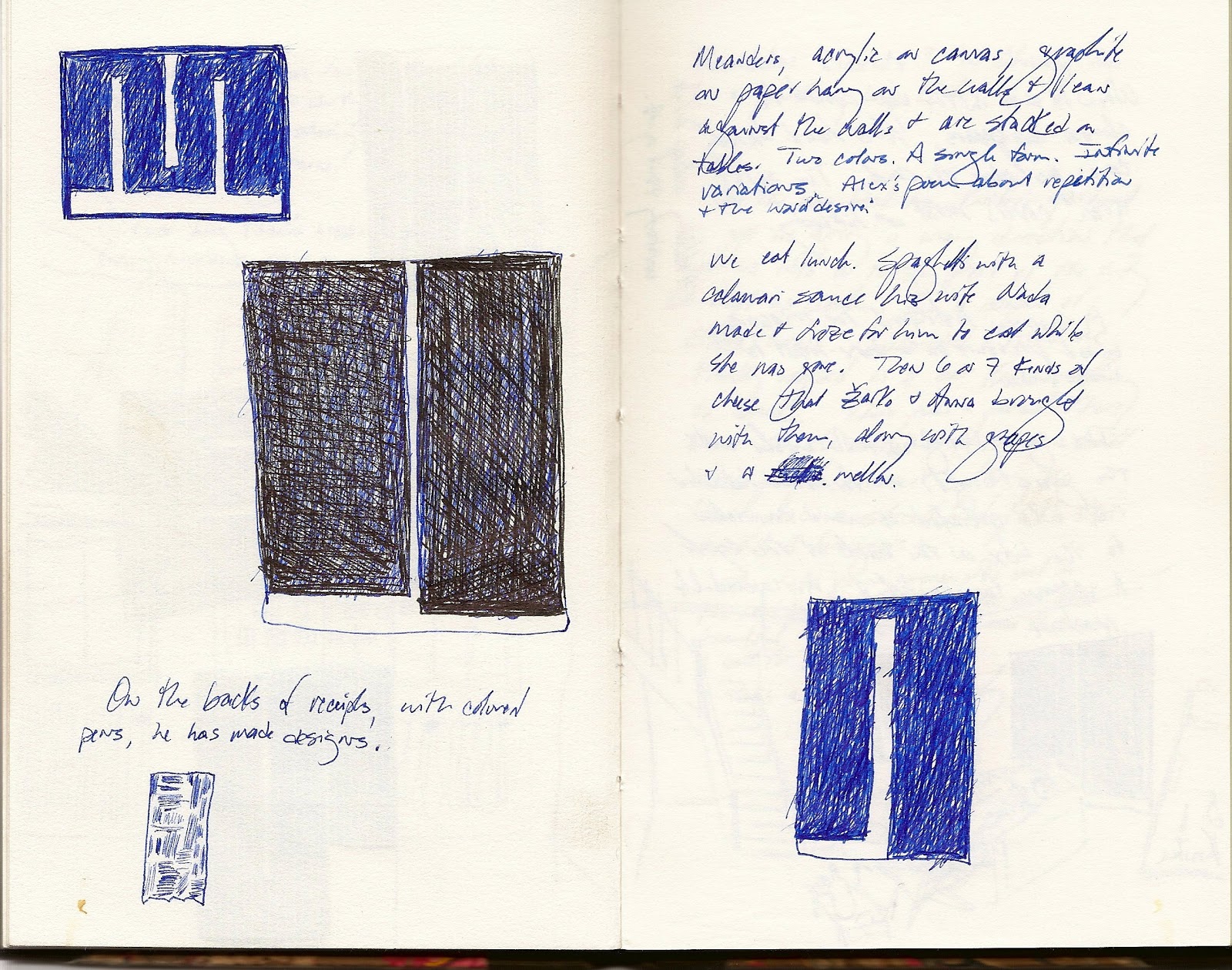
Zarko and I had spent the previous day with Peter Handke at his house in Chaville, just outside Paris, walking with him through the surrounding woods (in the Niemandsbucht) for hours. Still under his influence, we visited Knifer.


Stimulated by the Nina Pops drawings and by the question about Knifer, I got out my journal from that trip. Here are the pages, 9 December 1995:


Finally, Zarko's book, which I leaf through often, trying to pick out phrases I recognize, gazing through the Serbo-Croatian sentences as if through a glass darkly, hungry for the thoughts and structures of my friend's mind.


Divine Visitations + Looocky Loooke

Reading Karl Knausgaard's A Time for Everything, a novel about angels as fierce as the ones evoked in Rilke's Duino Elegies, I thought maybe I had glimpsed some angels, or at least their reflected glow, over the past two days.


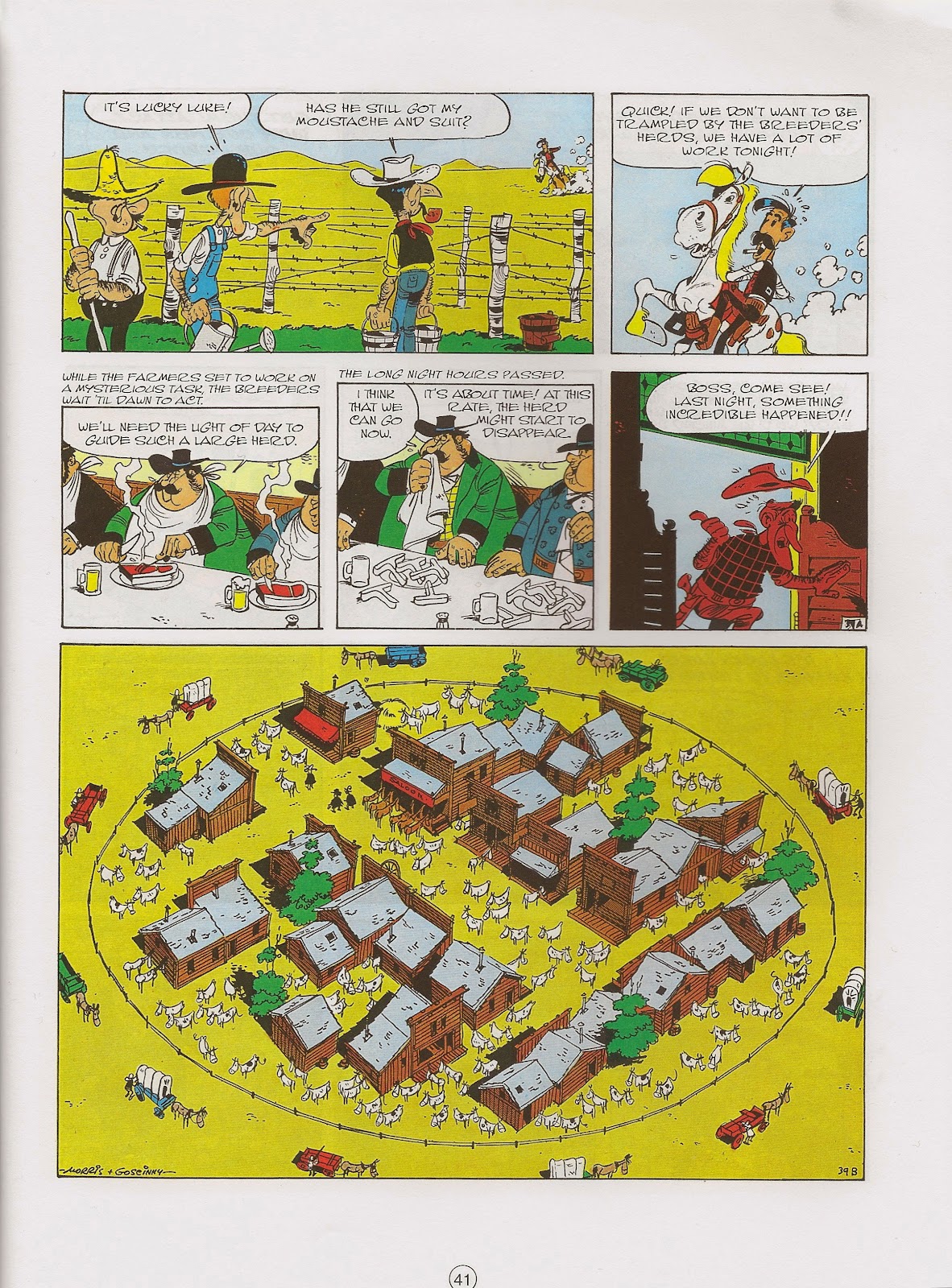
We're putting the finishing touches on our article "Literary Barbed Wire: Stretching and Cutting Barbed Wire from The Wire Cutters to 'Brokeback Mountain.'" Scanning a page from the comic book about Lucky Luke's adventures with barbed wire on the prairie (a French series that we have in translation), I remembered our French friend Celine who said she had read the whole series when she was a girl. Looocky Loooke, she said, and blushed a little when we pointed out the first name had to do with luck.


Thursday, July 12, 2012

The Virginian and Barbed Wire


Lyn and I have been working on our barbed-wire book. We wanted to cite Owen Wister's novel The Virginian from the original 1902 edition, so I bought a cheap copy. It's not a first edition—the book was reprinted repeatedly during that first year—but it does give a good sense for book-selling and buying sensibilities of the time.


I noticed, for instance, how important the cover is for a book published without a dust jacket. And then thought how dust jackets with their photographically reproduced designs subtract from the design of the actual book. The Andres Neuman Traveller of the Century I wrote about in the previous post, for instance, has a cover so bland as to make the word "bland" an overstatement.


By the levels of Bear Creek that reach like inlets among the promontories of the lonely hills, they came upon the schoolhouse, roofed and ready for the first native Wyoming crop. It symbolized the dawn of a neighborhood, and it brought a change into the wilderness air. The feel of it struck cold upon the free spirits of the cow-punchers and they told each other that, what with women and children and wire fences, this country would not long be a country for men. 


Tuesday, July 10, 2012

Translating the German Nineteenth Century


One of the strangest books I have read—the tensions start already in the author's Spanish/German name: Andrés Neuman. 

He grew up in Argentina, writes now in Spain, and at the age of 35 has produced a fat novel set in the Saxon—Prussian heart of the German nineteenth century. And: I'm reading the book in English, translated by Nick Caistor and Lorenza Garcia. It takes me a good 50 pages to settle down into the English—books with German characters and German settings really ought to be in German, shouldn't they? Or at least in the original Spanish? See the problem?

The setting is the town of Wandernburg, and like its name it is a shifty little place, not stable on maps and even its streets are moveable.

Hans, Herr Hans Hans, arrives by coach and senses immediately that it may be a difficult place to leave, although he is an inveterate traveller (I prefer traveler) who really means to move on the next day to Dessau where an invitation from Herr Lyotard awaits him.

Okay, I get it, it's an indeterminate place of shifting postmodern significance. It is also thoroughly, substantially, and sometimes delightfully rooted in nineteenth-centure material culture and intellectual history. It's a love story. It's a story about ideas (Fichte, Goethe, Schiller, Jean Paul, Tieck, Schleiermacher, Schopenhauer, Sophie von la Roche, Bettina von Arnim, the Schlegels, Cervantes, Calderon, Voltaire, etc. etc.). It's a story about translation. Herr Hans and Fräulein Gottlieb (Bodenlieb when she's making love with Hans) translate as feverishly as they make love—poems from the Russian, Spanish, French, and English for the publisher Brockhaus.

True to its essential (yes, essential) shiftiness, the novel is a twenty-first-century version of the twentieth-century Magic Mountain relocated on a nineteenth-century north-German plain.

Herr Hans, like Thomas Mann's Hans Castorp, arrives in a magical place he inexplicably can't leave. While the hot-cat object of Castorp's affection, Clawdia Chauchat, resides in room #7 of the sanatorium, Herr Hans Hans himself resides in room #7 of the inn in Wandernburg. And while another Thomas Mann magician bears the timely name Zeitblom, the inn's own is more simply Herr Zeit.

Neuman isn't the new Mann. He does, however, wear the mask skillfully.

A final question: once a reader has been transported to the land of shifting signifiers, on what basis can he or she complain about copy editing? Lubëck marzipan????? (p. 204). Someone from Farrar, Straus and Giroux ought to read Buddenbrooks.

Monday, July 9, 2012

Cloud Illusions

I've looked at clouds from both sides now
From up and down, and still somehow
It's cloud illusions I recall
I really don't know clouds at all


joni mitchell, both sides now


inverted commas: quoting mt. timpanogos

i'll leave this to dr. rorschach

calfshead

ghost of thomas jefferson

run little rabbit!


18 May 1989, Tübingen
I move among a group of baby hippos. Their skin is wrinkled and baby-soft. Two of them nuzzle up against me, nipping and sucking pleasantly at my arms. When one of the heavy mouths pulls at my left arm it frightens me.  I call for help. I begin to panic. The dream ends.
Nine a.m.  I sit on a bench atop the Österberg, remember the erotic beauty of a quiet morning in Seal Beach, California, the summer of 1972. A week's vacation from the clanging steel and chemical mud of the drilling rig. In the VW hatchback I had just bought for $600, I drove with Steve, our derrick hand, from Arizona to California to visit his sister. Driving through Yuma we disputed the meaning of Joni Mitchell's song "Both Sides Now." I remember vividly the evening with friends in a garden where we ate vast quantities of pasta, I watched them drink what seemed like gallons of wine, and we sang “Roll me over in the clover, roll me over, lay me down, and do it again.” The song, in endless rowdy variations, aroused my desire and my inhibitions alike. I had never been intoxicated, nor had I really, thoroughly rolled in the clover. Still, shyly, I savored the evening. Up early the next morning while Steve, his sister, and her partner still slept, I sat in the kitchen and scratched the slant of the morning sunlight onto paper.

Saturday, July 7, 2012

Of Local Interest


Still amazed at air that is humid + Blue and Bella (whose head scratching has the vet scratching his own head).